From an mRNA Display Hit to Enlicitide (5): From Oral Proof of Concept to a Real Drug
Starting from oral proof-of-concept lead Compound 1a, the team addressed oxidation, solubility, process-safety, and isomer liabilities through a five-module platform and selected Compound 18—MK-0616/Enlicitide.
From an mRNA Display Hit to Enlicitide (5): From Oral Proof of Concept to a Real Drug
From an mRNA Display Hit to Enlicitide · Part 5 · Final
Previous: How Does a Macrocyclic Peptide Begin to Become an Oral Drug?
“Oral” Was Not the Same as “Developable”
Part 4 crossed a threshold that had once seemed improbable. A highly engineered PCSK9 macrocyclic peptide, paired with a permeation-enhancing formulation, could reach useful systemic exposure after oral dosing and suppress its target in primates. But oral proof of concept was not the finish line. A clinical drug also has to remain stable, dissolve at a useful concentration, fit a reproducible formulation, and be manufactured safely and at scale.
The 2026 work begins with Compound 1a, a later, highly optimized oral proof-of-concept lead that had produced compelling cholesterol-lowering pharmacology and was considered as a potential clinical candidate. It should not be treated as another name for the 2021 paper's Compound 44, nor should the two papers be forced into an unsupported compound-by-compound lineage. In the 2026 campaign, Compound 1a was the explicit starting point for a new task: preserve the binding geometry and oral pharmacology while removing liabilities that could stop development.
Compound 1a Was Potent—and Still Not Enough
Four problems changed the optimization objective. A sulfur-containing DBX-derived motif was vulnerable to oxidation, including under storage conditions relevant to permeation-enhancer coformulation; straightforward sulfur replacement or oxidation fixes sharply reduced potency. Equilibrium solubility was only about 0.15 mg/mL in the authors' representative comparison, a serious constraint when enabled oral delivery depends on maintaining a high local concentration of dissolved drug.
The triazole-containing solution also relied on an azide intermediate, creating a process-safety issue for manufacturing—not an “explosive drug,” but a route that was less attractive to scale. Finally, Compound 1a contained an E-alkene whose preparation required control or separation of alkene isomers. None of these failures meant that it bound PCSK9 poorly. They meant that the definition of success had expanded beyond affinity.
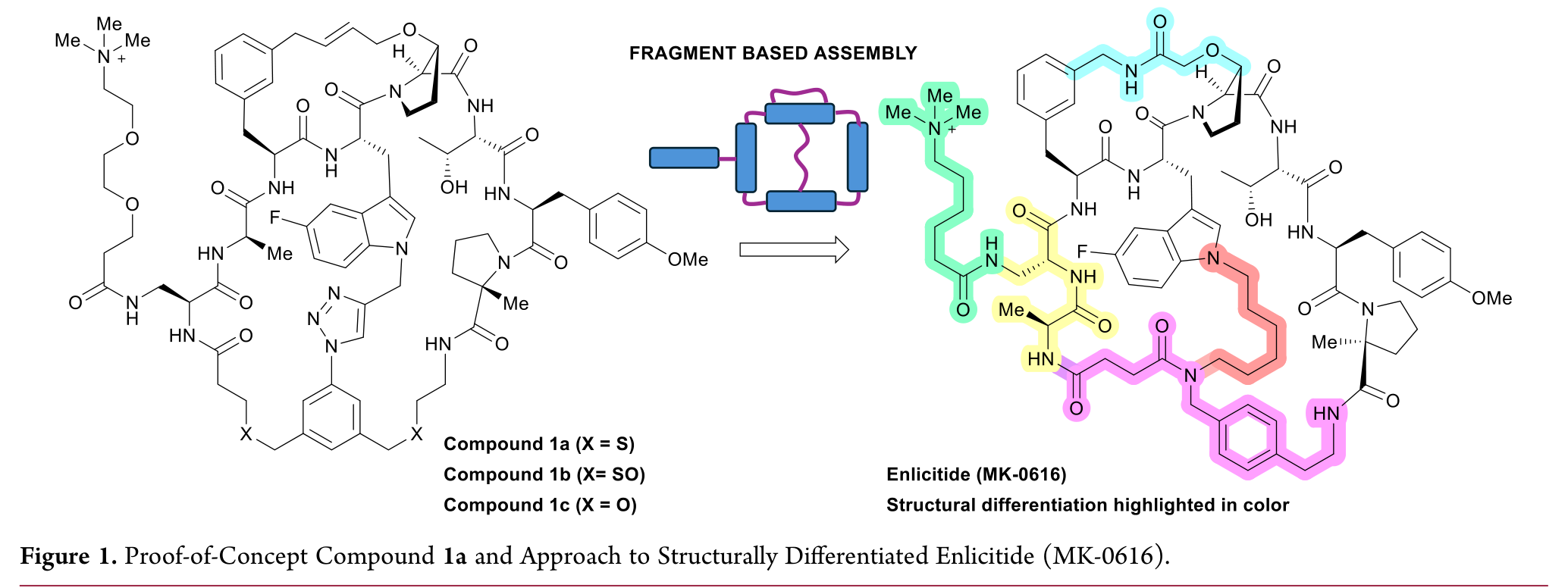
Figure 1. The corrected Figure 1 published by Josien and colleagues. The left side shows the genuinely cross-linked Compound 1a (X = S), together with oxidized analogues 1b (X = SO) and 1c (X = O); the right side shows Enlicitide (MK-0616). This image is cropped directly from the correction PDF, which fixes the central residue to (S)-5-fluorotryptophan. Compound 1a is not Compound 44. Source: DOI 10.1021/acs.jmedchem.6c02516; © 2026 American Chemical Society.
The Scaffold Was Redesigned, Not Patched
The team did not simply exchange one problematic atom at a time. It preserved the already optimized PCSK9-facing geometry while changing the architecture around it: a northern lactam staple, an N-benzylamide southern spacer, a ring-closing-metathesis-derived cross-link, and solvent-exposed motifs that could tune properties without disrupting the binding surface. This was late-stage, multiparameter redesign—stability, solubility, pharmacokinetics, process safety, and synthesis had to improve together.
Synthesis therefore became part of the discovery platform. The group organized solution-phase assembly into North, East, South, West, and Tail modules. Shared advanced intermediates could be recombined or locally replaced, shortening design–make–test–analyze cycles and producing enough material for broader preclinical profiling. The point was not a particular reagent or protecting group. It was that modular synthesis made complex-macrocycle optimization faster and more scalable.
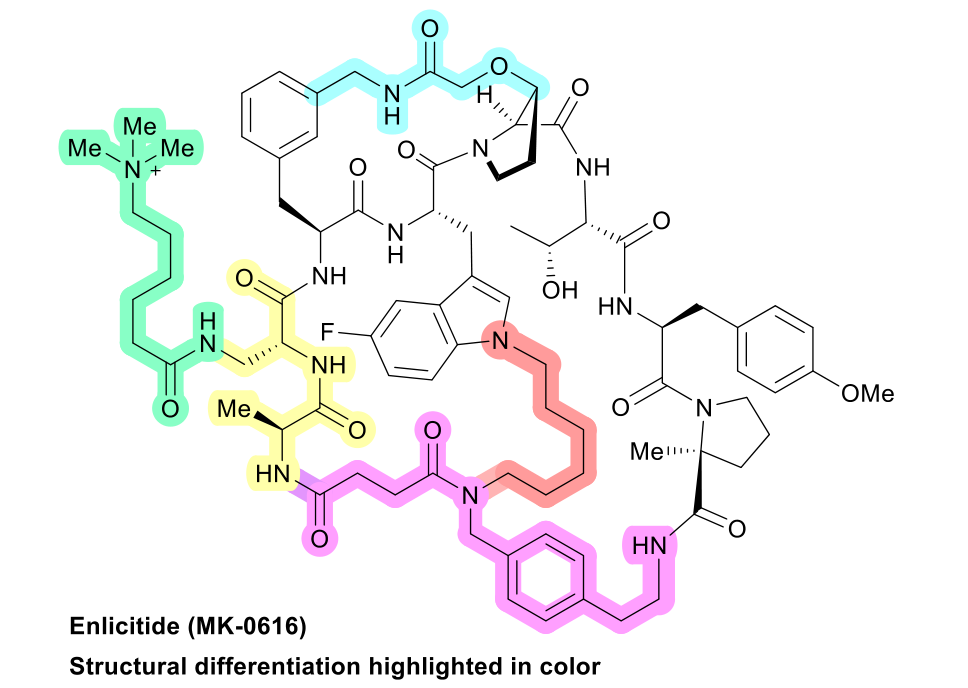
Figure 2. Enlarged Enlicitide panel from the corrected published Figure 1. The authors' original structural-differentiation colors are retained. They illustrate the redesigned architecture produced by fragment-based assembly; this article does not reinterpret those colors as an independent atom-by-atom North/East/South/West/Tail assignment. Source: DOI 10.1021/acs.jmedchem.6c02516; © 2026 American Chemical Society.
Compound 18 Won a Multiparameter Decision
Many redesigned molecules retained low-picomolar PCSK9 potency, so the lowest binding number no longer chose the winner. Solubility, chemical stability, clearance, preclinical PK, enabled oral absorption, and manufacturability became decisive. Compound 18 combined low-picomolar potency with favorable preclinical PK and the lowest unbound clearance among the compounds compared in the relevant rat profiling.
The solubility change made the development gain concrete. Against roughly 0.15 mg/mL for Compound 1a in the reported comparison, Compound 18 reached approximately 9 mg/mL equilibrium solubility across several pH conditions, and more than 70 mg/mL in the reported Labrasol- or sodium-caprate-containing media. These are condition-specific measurements, not a claim that every formulation has the same solubility. Together with acceptable formulation-enabled absorption, they supported selection for clinical progression.
The names now converge explicitly: Compound 18 = MK-0616 = Enlicitide. Compound 18 is the paper number, MK-0616 the development code, and Enlicitide the drug name.
The Oral Product Was Still Molecule Plus Formulation
Enlicitide did not become a conventionally permeable small molecule. In the reported preclinical studies, permeation enhancers such as Labrasol or sodium caprate increased exposure, consistent with absorption through upper-intestinal tight-junction/paracellular pathways; enhanced oral bioavailability remained in the low-single-digit range. High-fat feeding reduced exposure in monkeys. The correct conclusion is therefore not that molecular engineering alone solved intestinal permeability, but that molecular engineering and formulation engineering completed oral delivery together.
In cynomolgus monkeys, Compound 18 reduced free PCSK9 and LDL-C with exposure-dependent pharmacology, providing the preclinical bridge to clinical development. The molecule subsequently entered human studies, and the first Phase 3 results cited by the 2026 paper showed LDL-C reductions of about 60%. That clinical result is the consequence of the complete molecule–formulation system, not of affinity alone.
What Actually Happened Was a Series of Problems Being Solved
The regulatory endpoint is now official. FDA records show that Lipfendra, whose active ingredient is enlicitide decanoate, was approved on July 15, 2026 as an adjunct to diet and exercise to reduce LDL-C in adults with hypercholesterolemia, including heterozygous familial hypercholesterolemia. The approved tablet is taken at 20 mg once daily; FDA's multidisciplinary review identifies sodium caprate as a permeation enhancer in the tablet. Enlicitide and the enhancer remain distinct components of the product.
Looking back, no single step “created” Enlicitide. mRNA display supplied a place to start. Structural biology explained how the macrocycle recognized PCSK9. Noncanonical amino acids, N-methylation, and multiple cyclizations addressed stability and conformation. Medicinal chemistry tackled clearance, solubility, and safety. A permeation-enhancing formulation helped the large molecule cross the intestinal barrier. The final molecular and synthetic redesign turned effective chemical matter into a reproducible development candidate.
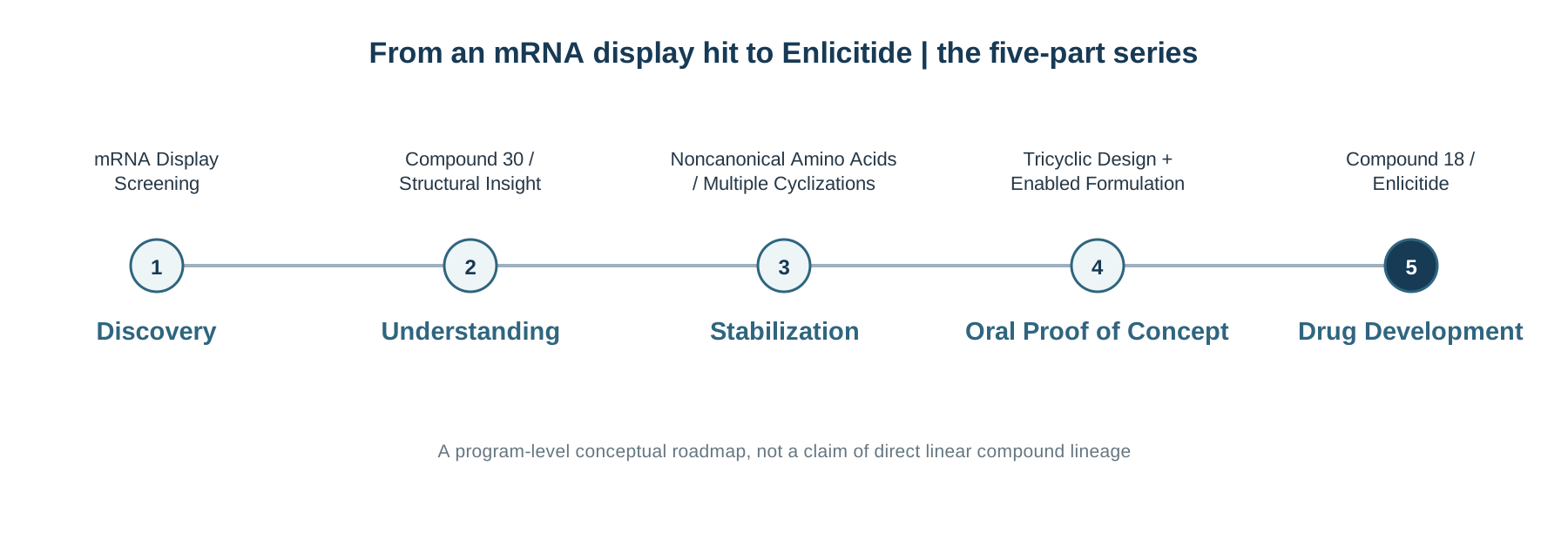
Figure 3. The five-part series closes as a program-level roadmap: discovery → understanding → stabilization → oral proof of concept → drug development. It does not claim that every numbered compound forms one direct linear chemical lineage.
From the first mRNA-display hit to Enlicitide, the documented story is not one lucky discovery. It is a sequence of different problems, solved one after another. That may be its most useful lesson for the next generation of macrocyclic peptide medicines.
Series complete: Part 1: The Story Begins with a Screen | Part 2: Seeing How the Macrocycle Binds PCSK9 | Part 3: Binding Well Is Not Enough | Part 4: How Does a Macrocyclic Peptide Begin to Become an Oral Drug? | Part 5 (Final) | Peptide Drugs
Scientific Sources and Regulatory Records
Josien H, Nair AG, Ding F-X, et al. Discovery Process of Enlicitide, a Highly Engineered Macrocyclic Peptide Therapeutic, through Issue-Driven Fragment-Based Synthetic Assembly and SAR. Journal of Medicinal Chemistry. 2026;69:13473–13491. https://doi.org/10.1021/acs.jmedchem.6c00463
Josien H, Nair AG, Ding F-X, et al. Correction to “Discovery Process of Enlicitide…” Journal of Medicinal Chemistry. 2026;69:21097–21098. https://doi.org/10.1021/acs.jmedchem.6c02516
Tucker TJ, Embrey MW, Alleyne C, et al. A Series of Novel, Highly Potent, and Orally Bioavailable Next-Generation Tricyclic Peptide PCSK9 Inhibitors. Journal of Medicinal Chemistry. 2021;64:16770–16800. https://doi.org/10.1021/acs.jmedchem.1c01599
U.S. Food and Drug Administration. FDA Approves First Oral PCSK9 Inhibitor to Lower LDL Cholesterol in Adults with High Cholesterol. July 17, 2026. FDA announcement
U.S. Food and Drug Administration. NDA 220848 Approval Letter and Multidiscipline Review. July 15, 2026. Approval letter | FDA review
Related services and resources: mRNA display technical resources | AI peptide design | custom peptide synthesis
Have a potent macrocyclic lead that now needs developability and process optimization?
Apollomics supports custom synthesis, structural confirmation, and multiparameter developability studies for noncanonical macrocycles, helping teams evaluate potency, stability, solubility, PK, and scale-up feasibility in parallel.