From an mRNA Display Hit to Enlicitide (4): How Does a Macrocyclic Peptide Begin to Become an Oral Drug?
From the established bicyclic platform to tricyclic Compound 35 and property-engineered Compound 44, the program combined potency, stability, PK, and an enabled formulation to demonstrate oral PCSK9 target engagement in primates.
From an mRNA Display Hit to Enlicitide (4): How Does a Macrocyclic Peptide Begin to Become an Oral Drug?
From an mRNA Display Hit to Enlicitide · Part 4
Previous: Binding Well Is Not Enough
Stability Still Did Not Mean Oral Delivery
By the end of Part 3, D-amino acids, N-methylation, and a second cyclization had made the original mRNA-display-derived PCSK9 macrocycles much more resistant to proteases. Compound 79 also showed why that achievement was incomplete: improved stability came with poor solubility. The next question was no longer simply how to make a peptide more stable. Could such a molecule actually move from the intestine into the bloodstream and produce useful systemic exposure?
The 2021 work continued from the previously established bicyclic lactam platform and other second-generation leads. This is a continuation of the chemical series, not a claim that Compound 79 was converted step by step into Compound 35 or Compound 44. That distinction matters because the researchers revisited several earlier cyclization ideas and recombined them around a new objective: preorganize the peptide more strongly while preserving the PCSK9-binding geometry.
From a Bicyclic Platform to a Tricyclic Peptide
One route replaced part of the amide-based bicyclic design with an olefin cross-link. The team then combined complementary cyclization strategies to produce a tricyclic scaffold. Compound 35 became the clearest expression of this approach, with PCSK9 inhibition in the picomolar range.
The third ring did not create a major new contact with PCSK9. Instead, structural comparisons indicated that it held the peptide more firmly in a binding-ready shape. A flexible molecule pays a conformational cost when it must reorganize before binding; preorganization reduces that cost. In plain terms, the added constraint did not provide another “hand” for gripping the target. It made the existing hands arrive in the right positions more often.
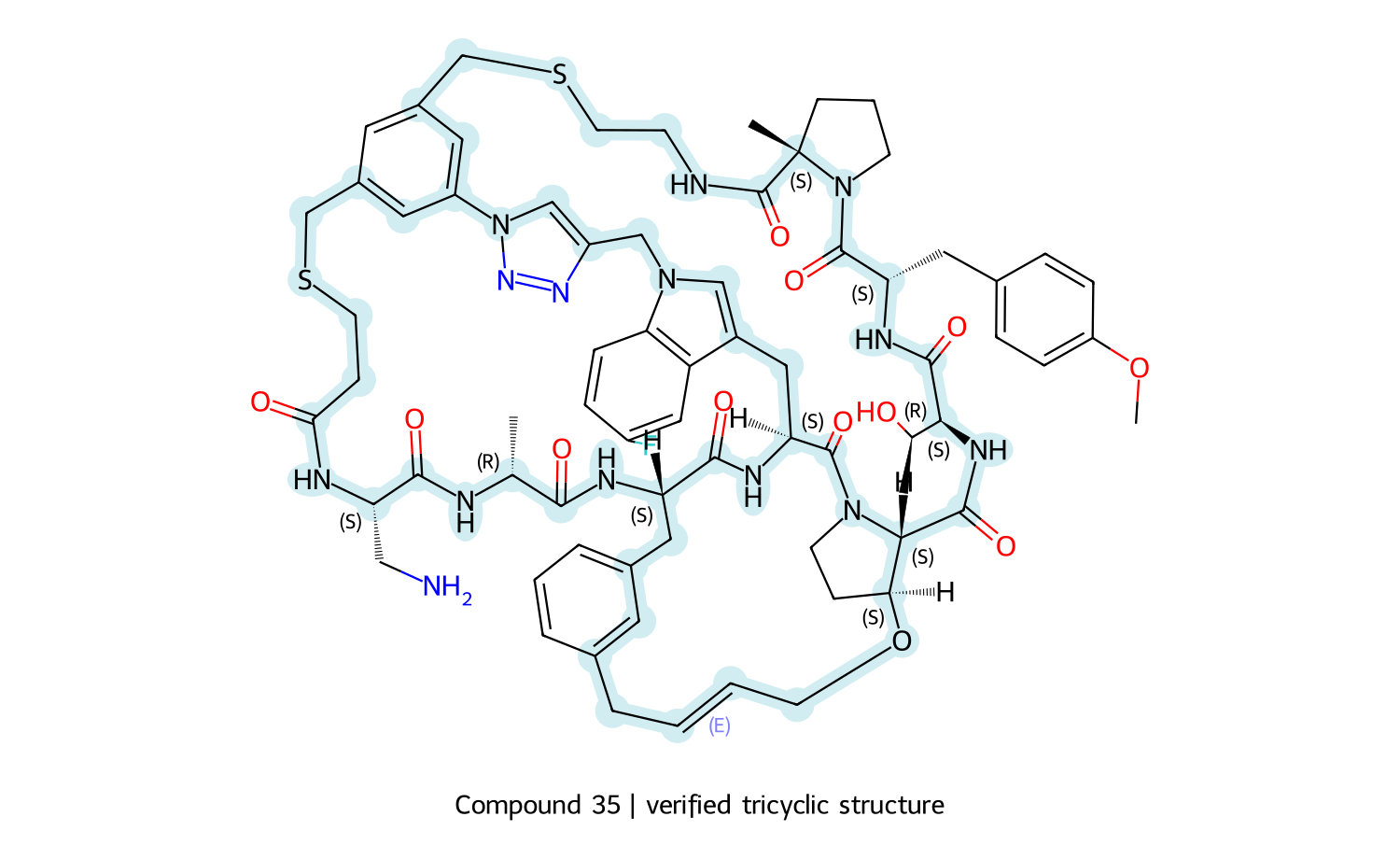
Figure 1. The chemically verified structure of Compound 35, rendered deterministically from the SMILES distributed with Tucker et al. The highlighted large-ring atoms show the three-cycle topology. The 2021 program continued from the previously established bicyclic platform and second-generation leads; this figure does not imply a direct Compound 79-to-35 lineage.
Potency Was Sufficient; PK Became the Problem
Once potency reached this level, making the binding number still smaller was no longer the main challenge. Compound 35 had very low passive permeability, poor oral absorption, and pharmacokinetic and physicochemical liabilities that a binding assay could not reveal. In standard vehicles it showed little or no oral bioavailability.
The team therefore began treating molecular design and formulation as two parts of the same oral-delivery problem. Labrasol was used in an enabled formulation—an oral formulation strategy containing a permeation enhancer. Even then, Compound 35 achieved less than 1% bioavailability after intraduodenal dosing in rats. Labrasol was not part of the peptide, and tricyclic design alone did not make the molecule freely permeable. The formulation was intended to help absorption, including through transient modulation of intestinal paracellular permeability, while medicinal chemistry still had to deliver a potent, stable molecule with suitable systemic PK.
A Solvent-Exposed Side Chain Changed the Molecule's Prospects
Crystal structures showed that some side chains pointed into solvent rather than making direct PCSK9 contacts. These positions offered handles for property engineering. A change there could alter polarity, solubility, transporter behavior, or clearance without rebuilding the target-facing surface.
Compound 39 introduced an amino-PEG side chain at such a position. It retained potency while improving polarity and solubility, reducing undesirable behavior associated with organic anion transporting polypeptides (OATPs), lowering clearance, and extending half-life. In the reported tests, the earlier mast-cell-degranulation concern was not reintroduced. The lesson was broader than a single substituent: a structural change that determines whether a drug can advance does not necessarily occur where the molecule touches its target.
Compound 44 took the same property-engineering logic further with a quaternary-ammonium-containing PEG-like side chain. This appendage was not designed to create a new PCSK9 contact. It changed the physicochemical and pharmacokinetic behavior of the whole molecule while retaining picomolar potency. In the reported assays, Compound 44 showed complete protease stability, stability in cynomolgus whole blood, no meaningful OATP1B1 inhibition across the tested range, no rat mast-cell-degranulation signal under the tested conditions, and improved PK.
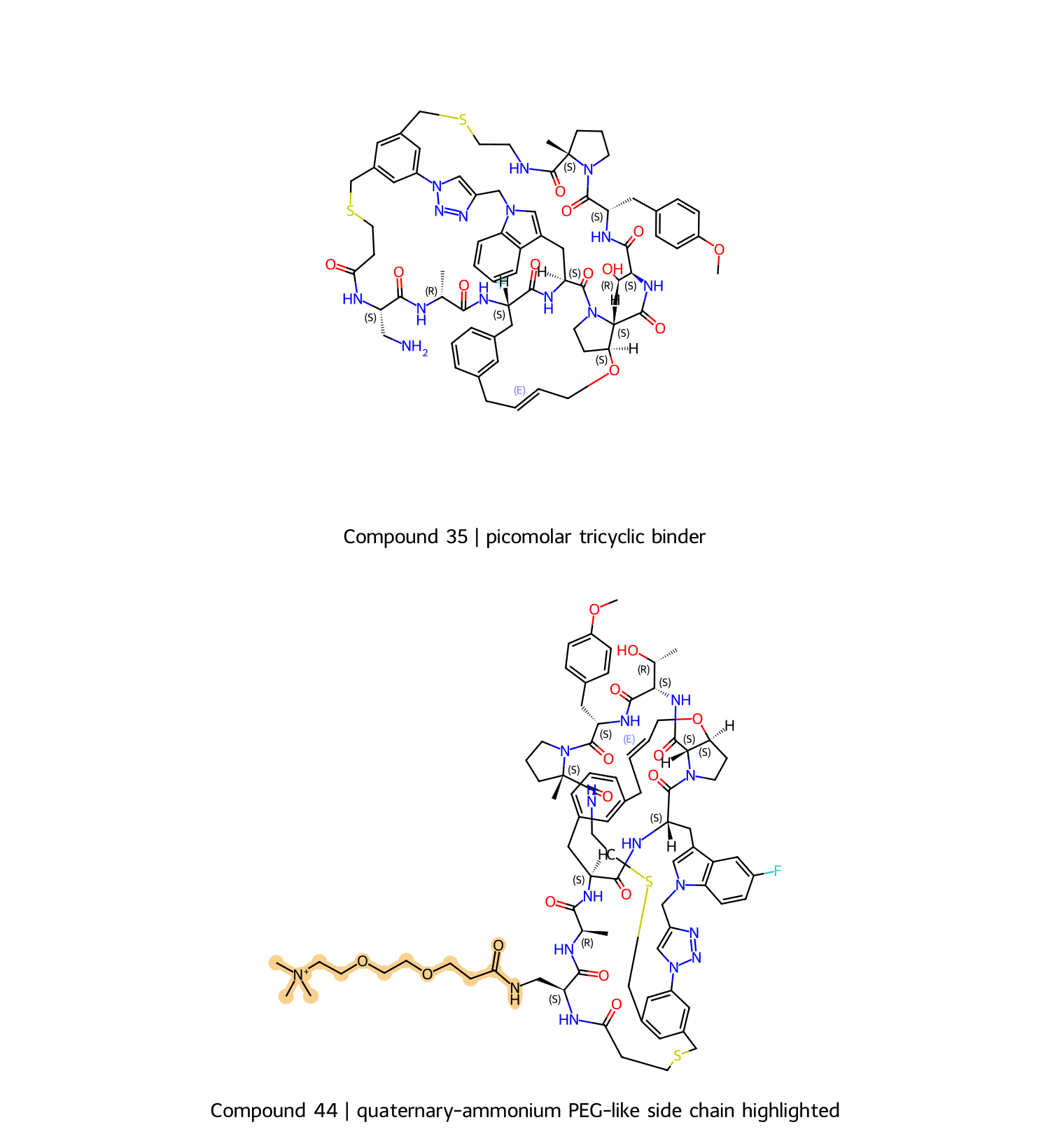
Figure 2. Compound 35 and Compound 44, redrawn by RDKit from the official ACS supporting-information SMILES for the 2021 paper. The highlighted region is the quaternary-ammonium PEG-like side chain appended at a solvent-exposed property-engineering position in Compound 44. Stereochemistry, ring closures, linker topology, and the side chain were checked against those machine-readable source structures and the paper's Scheme 10.
Could 2.9% Oral Bioavailability Be Useful?
In cynomolgus monkeys, a single 1 mg/kg oral dose of Compound 44 formulated in 30% Labrasol/PBS produced low but reproducible oral bioavailability of about 2.9%. That is not a high fraction, nor evidence that the peptide itself efficiently crossed the intestinal epithelium by passive diffusion. It is evidence that a carefully optimized molecule and a permeation-enhancing formulation could together produce measurable, useful systemic exposure.
Why could such a small percentage matter? Oral bioavailability is not the therapeutic endpoint. What matters is whether exposure is sufficient and reproducible enough to engage the target. Compound 44 combined extremely high potency, low clearance, persistence, and formulation-enabled absorption. In this specific PCSK9 macrocyclic-peptide series, those properties meant that useful target coverage did not require small-molecule-like percentage bioavailability.
The pharmacodynamic result made that distinction tangible. During the first several hours after the oral dose, free—or unbound—PCSK9 fell by approximately 80%, and target engagement remained substantial later. This was an oral target-engagement result. Separately, intravenous studies with Compounds 44 and 49 produced maximal LDL-C reductions greater than 50% and helped establish the broader PK-to-target-engagement-to-LDL-C relationship. The oral and intravenous evidence should not be collapsed into a claim that the single oral Compound 44 experiment directly demonstrated the same complete LDL-C endpoint dataset.
An Oral Peptide Did Not Have to Become a Small Molecule
Compound 44 clarified what “oral” meant for this program. Medicinal chemistry supplied picomolar potency, proteolytic stability, and systemic PK suitable for exploiting a small absorbed fraction. The Labrasol formulation helped that fraction cross the intestinal barrier. Neither component tells the whole story on its own.
For the first time in this series, high potency, protease stability, improved PK, enabled intestinal absorption, and strong primate target engagement had been brought together in one molecule-and-formulation experiment. Oral macrocyclic PCSK9 inhibition had moved from an attractive concept to an experimentally demonstrated possibility.
Compound 44, however, was not MK-0616 or enlicitide, and the 2021 paper did not identify the final clinical candidate. Development would expose another set of constraints: formulation compatibility, physicochemical stability, solubility, manufacturing, and scalable synthesis. An already orally available macrocycle still required another redesign before it could become a clinical candidate.
Next: From an mRNA Display Hit to Enlicitide (5): From Oral Proof of Concept to a Real Drug
Series: Part 1: The Story Begins with a Screen | Part 2: Seeing How the Macrocycle Binds PCSK9 | Part 3: Binding Well Is Not Enough | Part 4 | Peptide Drugs
Scientific Sources and Related Reading
Tucker TJ, Embrey MW, Alleyne C, et al. A Series of Novel, Highly Potent, and Orally Bioavailable Next-Generation Tricyclic Peptide PCSK9 Inhibitors. Journal of Medicinal Chemistry. 2021;64:16770–16800. https://doi.org/10.1021/acs.jmedchem.1c01599
Alleyne C, Amin RP, Bhatt B, et al. Series of Novel and Highly Potent Cyclic Peptide PCSK9 Inhibitors Derived from an mRNA Display Screen and Optimized via Structure-Based Design. Journal of Medicinal Chemistry. 2020;63:13796–13824. https://doi.org/10.1021/acs.jmedchem.0c01084
Related services and resources: mRNA display technical resources | AI peptide design | custom peptide synthesis
Have a potent macrocycle that now needs oral-exposure and PK optimization?
Apollomics supports custom synthesis, structural confirmation, and multi-parameter developability studies for noncanonical macrocycles, helping teams evaluate potency, stability, solubility, and pharmacokinetics together.