Why mRNA Display Is Especially Suited for Noncanonical Amino Acid and Cyclic Peptide Discovery
mRNA display combines genotype–phenotype linkage, cell-free translation, genetic code reprogramming, noncanonical amino-acid incorporation, macrocyclization, and iterative selection in one traceable discovery system.
Why mRNA Display Is Especially Suited for Noncanonical Amino Acid and Cyclic Peptide Discovery
The hardest part of peptide discovery is not simply making more sequences. For high-affinity binders, protease-resistant peptides, conformationally constrained ligands, macrocycles, and peptides containing noncanonical amino acids (NCAAs), the real challenge is to create a chemically meaningful library that can still be translated, selected, decoded, resynthesized, and experimentally validated.
mRNA display is especially useful in this setting because it connects four capabilities in one experimental system: genotype–phenotype linkage, cell-free translation, genetic code reprogramming, and iterative affinity selection. Its value is therefore not library size alone. It is the ability to place defined chemical diversity inside a traceable selection workflow.
The Core Mechanism: A Peptide That Carries Its Own Sequence Identity
In mRNA display, an mRNA template is connected to puromycin through a suitable linker. During in vitro translation, puromycin accepts the nascent peptide, producing a covalent mRNA–peptide fusion. The peptide is the phenotype being tested, while the attached nucleic acid preserves the genotype that identifies it.
After the library is exposed to a target, retained molecules can be recovered through their nucleic-acid component, reverse-transcribed, amplified, and sequenced. This is what makes phenotype traceable to sequence. The method is distinct from ribosome display, where the ribosome helps maintain a noncovalent complex, and from phage display, where peptides or proteins are presented by biological particles.
A representative workflow is:
DNA/mRNA library → cell-free translation → mRNA–peptide fusion → NCAA incorporation and/or cyclization → positive and counter-selection → recovery → RT–PCR → next round → sequencing
Why Very Large Libraries Matter—but Do Not Solve Everything
A 20-residue peptide built only from the 20 canonical amino acids already has a theoretical sequence space of 20²⁰. Adding NCAAs, alternative ring topologies, and backbone modifications expands the design space further. No practical experiment exhaustively samples it.
mRNA display can operate with libraries on the order of 10¹²–10¹³ members under suitable conditions. That scale is valuable because selection can search a much broader population than many cell-dependent formats. Yet nominal diversity is not the same as effective diversity. Oligonucleotide synthesis, transcription, aminoacylation, translation, fusion yield, cyclization, recovery, and amplification can all reshape the population before a target-binding event is measured.
The practical objective is therefore not “cover all chemical space.” It is to design a library whose diversity is large, chemically intentional, experimentally accessible, and compatible with the selection conditions.
Cell-Free Translation Changes the Design Rules
Because translation occurs outside living cells, mRNA display does not require every library member to be tolerated by a host, cross a membrane, remain stable inside a cell, or survive transformation. The translation mixture itself can be adjusted: amino acids may be omitted, codons reassigned, aminoacyl-tRNAs supplied, and translation components engineered.
This control is the basis for genetic code reprogramming. Depending on the system, vacant codons or stop codons can be assigned to selected NCAAs using precharged engineered tRNAs, flexizyme-based aminoacylation, or engineered aminoacyl-tRNA synthetase/tRNA pairs. The ribosome then installs those building blocks at encoded positions during library synthesis.
An early proof of this principle in mRNA display was reported by Li, Millward, and Roberts in 2002. They used amber stop-codon suppression to incorporate biocytin into an mRNA-display library and enriched the corresponding templates by selection on streptavidin. The experiment was deliberately simple, but it established that a genetically addressable noncanonical functionality could be introduced into a selectable and amplifiable mRNA-display population.
This distinction is central: the chemical diversity is present in the library during selection. Researchers are not limited to screening a canonical linear peptide first and chemically modifying one hit at a time afterward.
Chemically Available Does Not Mean Ribosomally Incorporable
A building block that is commercially available for solid-phase peptide synthesis is not automatically suitable for ribosomal synthesis. Reliable library incorporation requires several gates to be passed:
- the monomer must be loaded onto a compatible tRNA with useful efficiency;
- the aminoacyl-tRNA must remain sufficiently stable and compatible with the translation environment;
- EF-Tu or the relevant delivery machinery must accept it;
- the ribosome must accommodate peptide-bond formation and elongation;
- incorporation must remain sufficiently faithful across the intended sequence contexts.
These constraints are residue- and context-dependent. Single incorporation may work where repeated or consecutive incorporation fails. Bulky side chains, altered backbones, D-residues, β- or γ-amino acids, and N-methylated monomers can impose different barriers. Consequently, an NCAA library should be designed from experimentally supported translation chemistry rather than from an unrestricted supplier catalog.
What NCAAs Add to Peptide Discovery
NCAAs can introduce properties that the canonical alphabet does not efficiently cover. Depending on structure and position, they may provide D-stereochemistry, backbone N-methylation, α,α-disubstitution, larger aromatic surfaces, altered charge placement, reactive handles, or preorganized conformational preferences.
These changes can support several design hypotheses:
- reducing susceptibility to selected proteases;
- restricting local or global conformation;
- creating new hydrophobic, aromatic, electrostatic, or covalent interactions;
- changing solubility and membrane-interaction behavior;
- installing handles for compatible macrocyclization chemistry.
None is a guaranteed property improvement. A D-amino acid can disrupt a binding geometry; N-methylation can remove a required backbone hydrogen-bond donor; additional hydrophobic surface can increase nonspecific binding or aggregation. NCAA identity, position, neighboring residues, ring topology, and selection conditions must be interpreted together. For design considerations outside the display context, see How Noncanonical Amino Acids Improve Peptide Design Beyond Stability and The Role of Noncanonical Amino Acids in Drug Development.
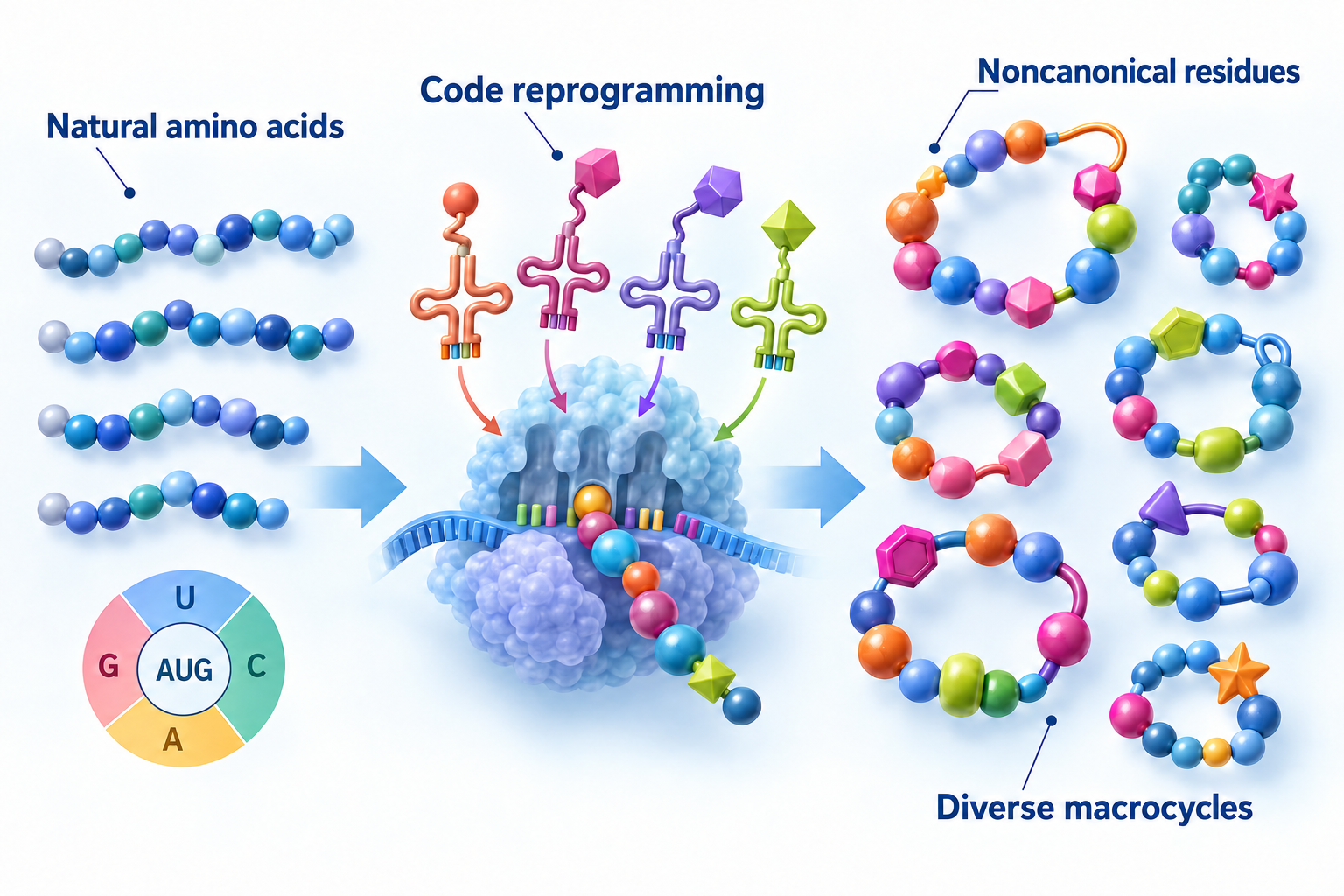
Figure 1. Genetic code reprogramming can place selected noncanonical residues into translated libraries, which can then be cyclized and screened as chemically diversified macrocycles.
Why mRNA Display Is Particularly Strong for Cyclic Peptides
Cyclization reduces the conformational freedom of a linear chain and can preorganize a binding-competent geometry. In favorable cases, a macrocycle can present a larger interaction surface than a conventional small molecule while retaining a defined structure and intermediate molecular size. These features may help address shallow or extended protein surfaces, including some protein–protein interaction interfaces that are difficult for conventional small-molecule screening.
The crucial advantage is that cyclization can occur at the library level. Translated peptides may undergo spontaneous or programmed ring closure, cysteine-based chemistry, electrophile-mediated cyclization, or other compatible post-translational reactions. Selection can therefore act on the actual cyclic molecules rather than on linear precursors that might be cyclized only after discovery.
Combining cyclization with NCAAs can alter side-chain chemistry, backbone conformation, ring topology, protease susceptibility, and target-contact geometry at the same time. This creates richer constrained-peptide libraries, but it also adds quality-control requirements: cyclization efficiency may vary by sequence, side reactions may occur, and the displayed product distribution may differ from the intended design.
Practical decisions about ring size, anchor placement, topology, and synthesis are discussed further in From Linear Peptides to Cyclic Peptides: When Is Cyclization Worthwhile?.
Positive Selection and Counter-Selection Shape Specificity
A typical positive-selection step retains library members that bind the target while washing away weaker or nonbinding molecules. Binding to the target alone, however, is rarely sufficient. Sequences may bind the solid support, affinity tag, blocking reagent, abundant matrix components, or homologous proteins.
Negative or counter-selection can remove these unwanted populations before or alongside positive selection. The design may include blank beads, an unrelated protein, a close homolog, or a matrix-matched control. The appropriate counter-target depends on the biological question: eliminating homolog binding can improve selectivity, but an overly aggressive counter-selection can also discard useful cross-reactive families.
Across rounds, selection changes the distribution of sequences. The most informative output is not merely a list from the final round, but the enrichment trajectory, depleted population, family structure, motif conservation, positional tolerance, and behavior under positive versus negative pressure.
Why These Data Can Support Computational Models
Round-resolved sequencing can produce richer supervision than a single hit/non-hit label. With adequate controls and metadata, a dataset may include enriched and depleted sequences, counter-selection behavior, monomer identity, ring format, sequence families, positional preferences, and measured validation results.
Such data can support clustering, enrichment prediction, candidate ranking, sequence optimization, generative design, and experimental prioritization. The model must still respect the library chemistry and the biases of the selection process. Enrichment is not a universal affinity label, counts from different campaigns are not automatically comparable, and computational predictions do not replace resynthesis or orthogonal assays. See How AI Can Optimize an Existing Peptide and Why AI-Designed Peptides Still Need Synthesizability Screening for the downstream design perspective.
Important Technical Limitations
mRNA display is powerful precisely because several molecular processes are coupled, but each process can introduce bias.
- Translation bias: different sequences and monomers can be translated or fused with different efficiencies.
- Aminoacylation bias: the yield and quality of charged tRNA affect NCAA incorporation.
- Cyclization bias: not every sequence reaches the intended cyclic product at the same rate or yield.
- Selection artifacts: matrix binding, aggregation, target presentation, avidity, and washing conditions can produce misleading enrichment.
- PCR and sequencing bias: amplification and readout can distort apparent abundance.
- Binding is not development: a selected binder is not yet a drug candidate.
These limitations call for controls, replicate analysis, round-by-round sequencing, independent resynthesis, and orthogonal validation—not for abandoning the platform.
From a Selection Hit to a Defined Experimental Peptide
A practical hit-to-lead path is:
sequence confirmation → independent chemical resynthesis → identity and purity analysis → binding validation → functional assay → structure/SAR analysis → NCAA and cyclization refinement → solubility, stability, and synthesizability assessment → project-specific pharmacology
This transition is important because display-library chemistry must become a defined chemical structure and purified material. A sequence can enrich strongly but fail during resynthesis, adopt a different cyclization product, lose activity without the display construct, or show poor solubility. Custom synthesis and analytical quality control therefore form part of discovery rather than a separate afterthought. For practical manufacturing considerations, see the Custom Peptide Synthesis Guide.
mRNA Display and Phage Display Serve Different Design Spaces
Phage display remains a mature and useful technology. mRNA display differs in being cell-free, in supporting very large libraries, and in offering more direct access to some genetic-code-reprogramming strategies. These characteristics can make it better suited to certain NCAA-rich and macrocyclic library designs. They do not make it universally superior: target format, scaffold, laboratory capabilities, desired chemistry, and downstream application determine which display technology is appropriate.
Conclusion
The value of mRNA display is not simply that it can generate a large peptide library. It brings genetic encoding, cell-free translation, selected noncanonical amino acids, compatible cyclization chemistry, affinity selection, and sequence recovery into one iterative system.
For NCAA-containing cyclic peptides, the meaningful goal is not to produce more sequences for their own sake. It is to build chemical space that is encodable, translatable, cyclizable, selectable, resynthesizable, and experimentally verifiable.
References
- Roberts RW, Szostak JW. RNA-peptide fusions for the in vitro selection of peptides and proteins. PNAS. 1997;94:12297–12302. doi:10.1073/pnas.94.23.12297
- Li S, Millward S, Roberts RW. In Vitro Selection of mRNA Display Libraries Containing an Unnatural Amino Acid. Journal of the American Chemical Society. 2002;124:9972–9973. doi:10.1021/ja026789q
- Kamalinia G, et al. Directing evolution of novel ligands by mRNA display. Chemical Society Reviews. 2021;50:9055–9103. doi:10.1039/D1CS00160D
- Josephson K, Ricardo A, Szostak JW. mRNA display: from basic principles to macrocycle drug discovery. Drug Discovery Today. 2014;19:388–399. doi:10.1016/j.drudis.2013.10.011
- Yamagishi Y, et al. Natural Product-Like Macrocyclic N-Methyl-Peptide Inhibitors against a Ubiquitin Ligase Uncovered from a Ribosome-Expressed De Novo Library. Chemistry & Biology. 2011;18:1562–1570. doi:10.1016/j.chembiol.2011.09.013
- Peacock H, Suga H. Discovery of De Novo Macrocyclic Peptides by Messenger RNA Display. Trends in Pharmacological Sciences. 2021;42:385–397. doi:10.1016/j.tips.2021.02.004
- Goto Y, Suga H. The RaPID Platform for the Discovery of Pseudo-Natural Macrocyclic Peptides. Accounts of Chemical Research. 2021;54:3604–3617. doi:10.1021/acs.accounts.1c00391
- Iskandar SE, et al. Enabling Genetic Code Expansion and Peptide Macrocyclization in mRNA Display via a Promiscuous Orthogonal Aminoacyl-tRNA Synthetase. Journal of the American Chemical Society. 2023;145:1512–1517. doi:10.1021/jacs.2c11294
- Katoh T, Suga H. Reprogramming the genetic code with flexizymes. Nature Reviews Chemistry. 2024;8:879–892. doi:10.1038/s41570-024-00656-5
Exploring NCAA-containing cyclic peptide discovery and optimization?
If your project involves a protein target, peptide hit, macrocycle, or noncanonical amino acid design, we can support candidate design, structural and chemical feasibility assessment, custom peptide synthesis, purification, and analytical quality control.