From an mRNA Display Hit to Enlicitide (1): The Story Begins with a Screen
PCSK9 was a validated yet difficult protein–protein interaction target. mRNA display found two cyclic-peptide hit series in a vast chemical space, but a binder was only the beginning of the drug-discovery journey.
From an mRNA Display Hit to Enlicitide (1): The Story Begins with a Screen
From an mRNA Display Hit to Enlicitide · Part 1
How Far Is an mRNA Display Hit from a Real Drug?
The development of enlicitide (MK-0616) has made an orally administered macrocyclic peptide one of the most closely watched case studies in peptide drug discovery. In retrospect, the project is easily compressed into a single sentence: “PCSK9 macrocycles were discovered by mRNA display and then optimized into an oral drug candidate.” The real discovery process was far more complicated.
Following the program from its initial mRNA display screen raises a more useful question: what did mRNA display actually contribute to drug discovery? Once a target-binding macrocycle had been found, how far was it from a molecule that could genuinely be developed as a drug?
In 2020, Alleyne and colleagues reported in the Journal of Medicinal Chemistry a series of PCSK9 macrocyclic inhibitors derived from an mRNA display screen. Those compounds were not direct products of screening alone. The story begins with the nature of PCSK9 as a target and with the distinct cyclic-peptide series recovered from the original selection.
A Validated Target Without an Obvious Way to Inhibit It
PCSK9 was not an unvalidated target. It helps regulate the level of LDL cholesterol in blood. In simplified terms, PCSK9 promotes degradation of the LDL receptor (LDLR). Blocking the PCSK9–LDLR interaction allows more LDLR to return to the cell surface and continue clearing LDL cholesterol from circulation.
Anti-PCSK9 antibodies had already shown that this pathway was clinically effective. The central scientific risk was therefore not whether inhibiting PCSK9 could work. It was whether a molecule much smaller than an antibody could block the interaction between PCSK9 and LDLR.
That was difficult because the LDLR-binding region on PCSK9 is not a conventional small-molecule pocket. It is a comparatively broad, flat protein surface—the kind of protein–protein interaction interface that conventional small molecules often struggle to address.
Macrocyclic peptides were an attractive modality. They are larger than ordinary small molecules and can engage a broader protein surface, yet they remain far smaller than antibodies. With the right sequence and three-dimensional conformation, a macrocycle can occupy useful chemical space between those two modalities. This does not mean that macrocycles are inherently orally bioavailable; at this stage, the immediate question was simply what a productive PCSK9-binding macrocycle might look like.
Instead of Guessing, Screen
A peptide of roughly a dozen residues already has an astronomical number of possible sequences even when only canonical amino acids are considered. Noncanonical amino acids, stereochemical alternatives, and different cyclization strategies expand that chemical space still further. Designing, synthesizing, and testing those possibilities one at a time cannot explore it meaningfully.
This is where mRNA display becomes useful for noncanonical-amino-acid and cyclic-peptide discovery. Each peptide remains linked to the mRNA that encodes it. A very large peptide library can then be exposed to PCSK9: molecules that do not bind effectively are washed away, while retained molecules can be identified through their attached nucleic-acid “identity cards,” amplified, and carried into the next selection round. Readers looking for a step-by-step view of this population process can also see what happens during one round of mRNA display selection.
In this campaign, the linear library peptides contained two reactive thiols and were cyclized with 1,3-di(bromomethyl)benzene (DBX). After multiple selection rounds, the initially complex population converged on two novel, structurally distinct cyclic-peptide hit series. PCSK9 therefore appeared to permit more than one productive recognition solution.
An especially revealing detail is that compound 2—the series chosen for deeper medicinal-chemistry work—was not the more potent of the two initial hits. Screening potency is important, but it is not the only criterion that determines whether a hit becomes a useful starting point. A tractable scaffold and the opportunities it offers for simplification and optimization can matter just as much.
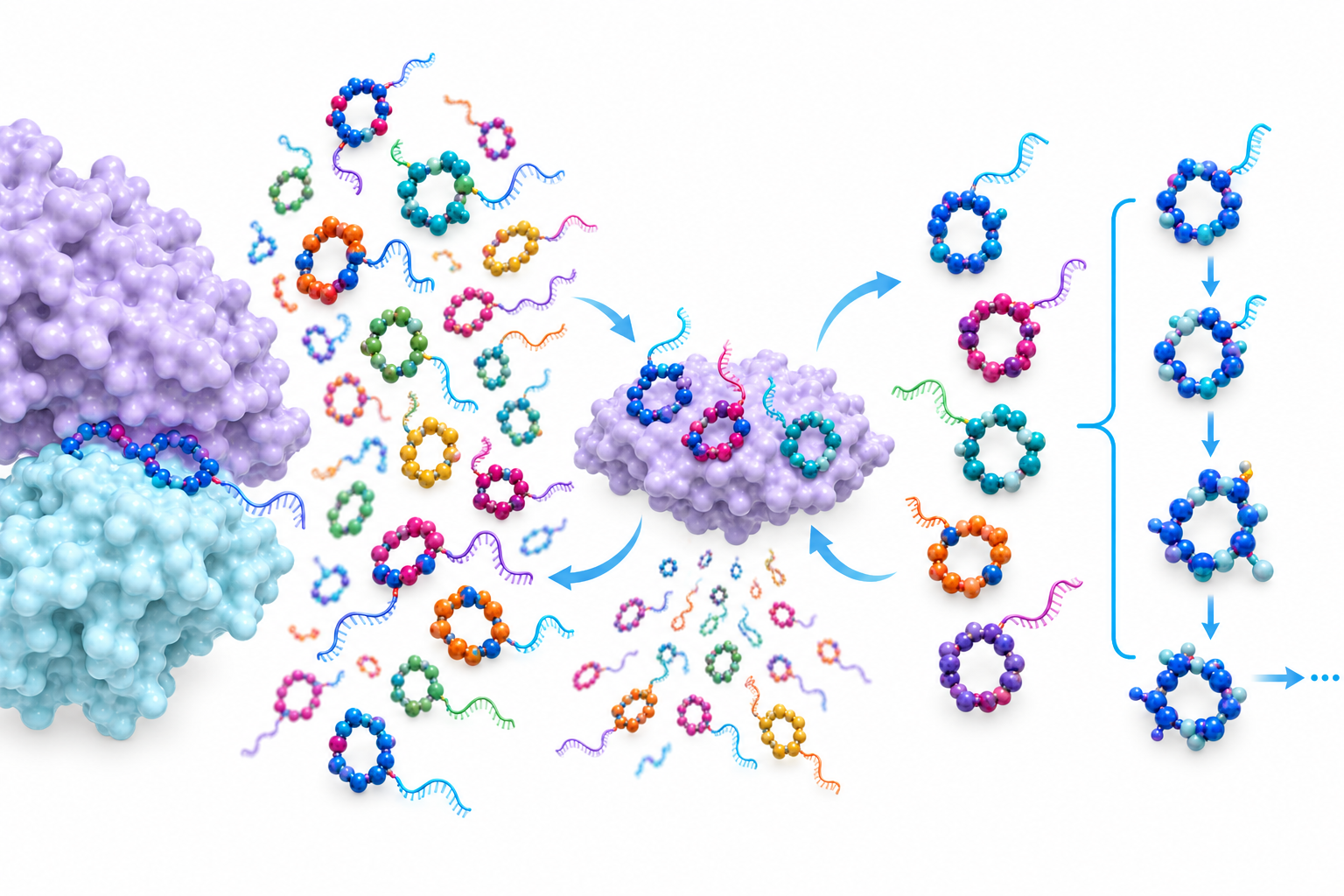
Figure 1. Finding a Starting Point in a Vast Chemical Space. mRNA display found the starting point, not the final drug.
Finding a Hit Is Where the Story Really Begins
This is one of the easiest parts of the enlicitide story to miss. mRNA display is very good at answering, “What kind of molecule can bind this target?” Drug development must answer many more questions.
Strong binding to PCSK9 does not mean that a molecule will remain stable in the body. Stability does not ensure passage through the intestine; absorption does not guarantee suitable pharmacokinetics. Even after those problems are addressed, solubility, chemical stability, synthesis, and manufacturing at scale still matter.
mRNA display therefore found not a drug, but a starting point worth investing in.
The PCSK9 program demonstrated this quickly. Researchers resynthesized the screen-derived macrocycles and did something very traditional: they removed regions that appeared unnecessary. Truncation of the N-terminal region of compound 2 produced smaller analogues. A substantial part of the original hit could be removed while potency was maintained or improved, and compound 4 emerged as an important early analogue.
In other words, mRNA display had found a molecule that worked, but it had not delivered that molecule in its simplest or most developable form. The question changed from “What binds PCSK9?” to “How can this molecule be made more drug-like?” Medicinal chemistry was only beginning.
The First Reality Check Arrived Quickly
When the early macrocycles were evaluated more seriously, good binding alone proved insufficient. They showed instability in protease environments, metabolic liabilities, and short in-vivo half-life or pharmacokinetic limitations. A PCSK9 inhibitor that looked promising in an in-vitro binding assay faced an entirely different set of pressures in a biological system.
This is a familiar tension in peptide drug discovery. Peptides can recognize proteins efficiently in part because their backbones and side chains offer rich interaction chemistry. The same structures can also become recognition and cleavage sites for proteases. Converting a high-affinity peptide into a drug demands repeated trade-offs between preserving target binding and changing molecular properties.
Fortunately, the team no longer had to start from nothing. It had a molecule that could bind PCSK9 and could now determine which parts were indispensable, which could be changed, and which contributed to instability. That is where medicinal chemistry began to do the long, iterative work.
Noncanonical Amino Acids Were Present from the Start
One detail is especially important. The PCSK9 mRNA display library was not a simple collection restricted to the standard amino acids. It already incorporated noncanonical building blocks, including 5-fluorotryptophan (5F-Trp).
Later experiments showed that one key 5F-Trp was important for binding to PCSK9. The authors noted that including 5F-Trp in the amino-acid set explored during the original mRNA display campaign was critical to discovery of the series.
The implication is broader than one SAR result. If a display library is limited to canonical amino acids, even a very large library still explores a restricted chemical space. Introducing experimentally compatible noncanonical amino acids into the screening system lets selection test whether those added chemical features are valuable, rather than waiting for chemists to add them one by one after a canonical hit has been found. It does not imply that any arbitrary NCAA can be encoded; incorporation remains dependent on the translation system and the building block. For more context, see why mRNA display is particularly suited to NCAA and cyclic-peptide discovery.
This is a central attraction of combining mRNA display, macrocycles, and noncanonical amino acids: expanding a library can mean not only increasing sequence diversity, but also widening the chemical diversity that an experiment can select.
What mRNA Display Really Solves Is Where to Begin
Today we know that the program ultimately went much further. At the time of the initial mRNA display screen, however, no one knew whether these macrocycles could ever become orally administered molecules. The researchers initially had only several cyclic peptides capable of recognizing PCSK9.
One series was advanced. The molecule was made smaller, its activity was reconfirmed, and problems with stability and in-vivo behavior soon emerged. Conformation, metabolism, solubility, permeability, oral absorption, and manufacturing still lay ahead.
The enlicitide story is therefore not a story in which “mRNA display screened out a drug.” It shows something more precise: when a protein surface is difficult for conventional small molecules, mRNA display can search an enormous chemical space and find a molecule from which a serious drug-discovery effort can begin.
Finding a genuinely worthwhile place to begin is itself one of the hardest tasks in drug discovery. mRNA display found that starting point. Enlicitide was still far away, but the story had begun.
Next: Seeing How the Macrocycle Binds PCSK9 for the First Time
The early macrocycles exposed developability problems, but structural biology also began to reveal how this scaffold recognized the broad PCSK9 surface. The next article will follow the first structural insights and show how “seeing” the complex changed the optimization questions that medicinal chemists could ask.
Scientific Source
Alleyne C, Amin RP, Bhatt B, et al. Series of Novel and Highly Potent Cyclic Peptide PCSK9 Inhibitors Derived from an mRNA Display Screen and Optimized via Structure-Based Design. Journal of Medicinal Chemistry. 2020. https://doi.org/10.1021/acs.jmedchem.0c01084
Moving from an ultra-large library screen toward a developable candidate?
Apollomics supports custom synthesis, structural confirmation, and early developability studies for cyclic and noncanonical-amino-acid peptides to help teams validate and advance screening hits.