mRNA Display: Discovering High-Affinity Peptides from Ultra-Large Libraries
mRNA display uses a puromycin-mediated covalent linkage so that each peptide carries its own sequence identity, enabling iterative selection from libraries on the order of 10¹²–10¹³ molecules and supporting cyclic-peptide, NCAA and data-driven discovery.
mRNA Display: Discovering High-Affinity Peptides from Ultra-Large Libraries
mRNA display is an in vitro selection technology that physically links a peptide to the nucleic-acid sequence that encodes it. That simple principle makes it possible to construct highly diverse peptide libraries, select molecules that bind a target, and recover their identities by amplifying and sequencing the attached genetic material.
The method has become particularly valuable for discovering cyclic peptides and peptides containing noncanonical amino acids (NCAAs). Its strength does not come from library size alone: genotype–phenotype linkage, programmable translation chemistry, iterative selection and sequencing work together as one experimental system.
What Is mRNA Display?
In mRNA display, an mRNA template is connected to puromycin through a suitable linker. During in vitro translation, puromycin enters the ribosomal peptidyl-transferase center and accepts the nascent peptide chain. The result is a covalent mRNA–peptide fusion: the peptide is the phenotype being tested, while its attached mRNA preserves the genotype that identifies its sequence.
This covalent linkage is fundamental. The peptide is not merely located near an unrelated RNA molecule; each displayed peptide carries the sequence information that encoded it. After selection, the nucleic-acid portion can be reverse-transcribed, amplified and sequenced, allowing a binding event to be traced back to a peptide sequence.
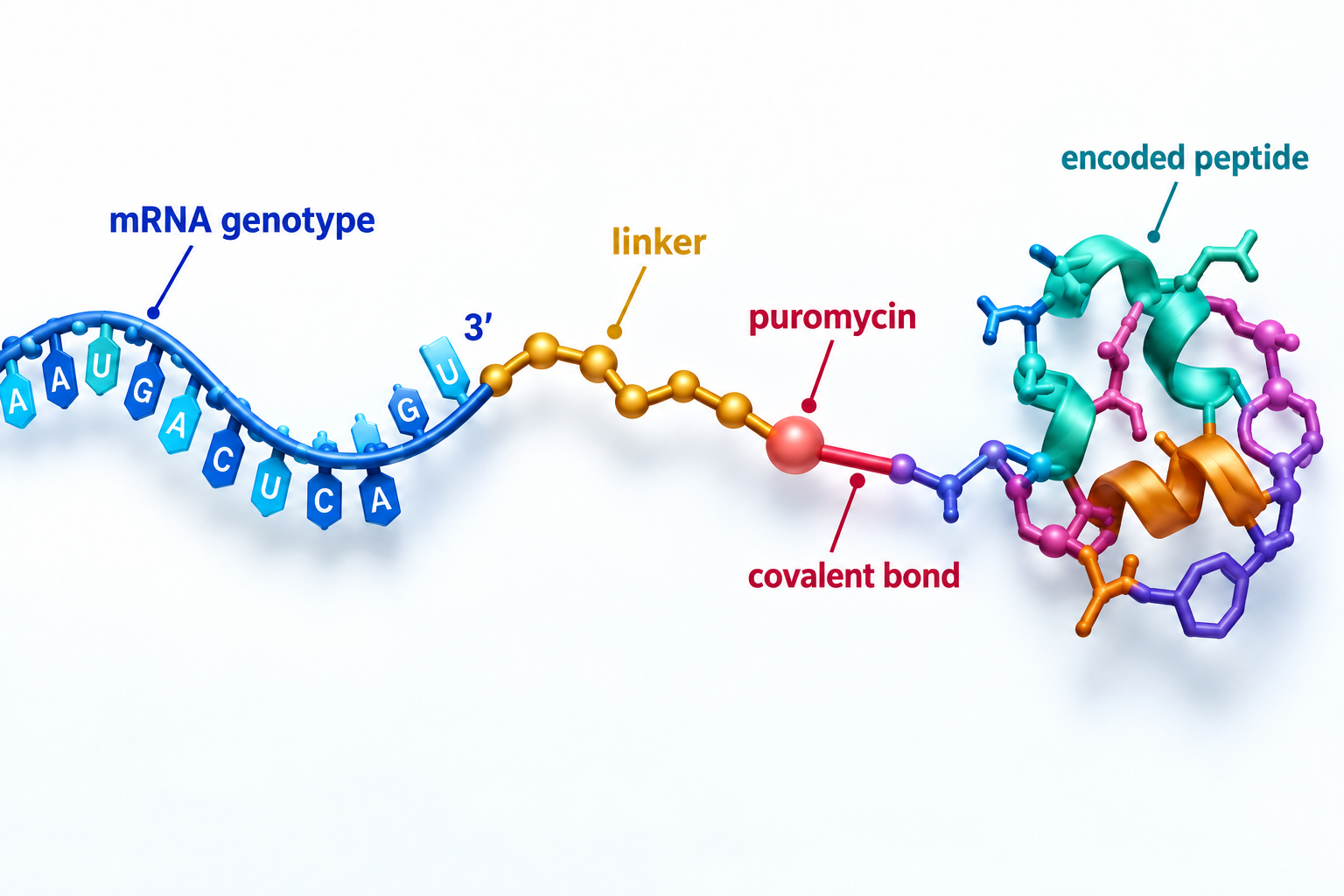
Figure 1. Principle of mRNA Display. Puromycin-mediated covalent linkage keeps peptide phenotype and sequence identity on the same molecule.
Why Can the Libraries Be So Large?
mRNA display is cell-free. In display systems that depend on cellular transformation, the number of variants that enter and remain viable in cells can constrain practical library size. mRNA display instead generates and handles the library in vitro, without requiring every candidate to pass through a living cell.
Depending on template preparation, translation efficiency, fusion yield and downstream handling, libraries on the order of approximately 10¹²–10¹³ molecules may be explored. This is a representative range, not a guaranteed size for every experiment. Effective diversity can be lower than the nominal input if synthesis bias, translation bias, fusion efficiency or sample losses are substantial.
A very large library also does not automatically produce a useful ligand. Library architecture, target quality, selection pressure, counter-selection and the ability to distinguish specific enrichment from background all matter.
A Representative Selection Cycle
A typical workflow begins with a DNA library that is transcribed into an mRNA library. Each mRNA is linked to puromycin, translated in vitro and converted into an mRNA–peptide fusion. The fusion library is exposed to an immobilized or otherwise separable target. Nonbinding material is removed by washing; retained fusions are recovered, reverse-transcribed and amplified for the next round. After repeated rounds, next-generation sequencing can reveal enriched sequences and related families.
A representative sequence is:
DNA library → transcription → mRNA library → puromycin linkage → in vitro translation → mRNA–peptide fusion → target selection → washing → recovery → reverse transcription/PCR → next round → sequencing
Protocol details vary. For example, reverse transcription may be performed before or after affinity selection, and different formats use different fusion-purification and recovery steps. The diagram below therefore describes the logic of iterative selection rather than a mandatory order for every protocol.
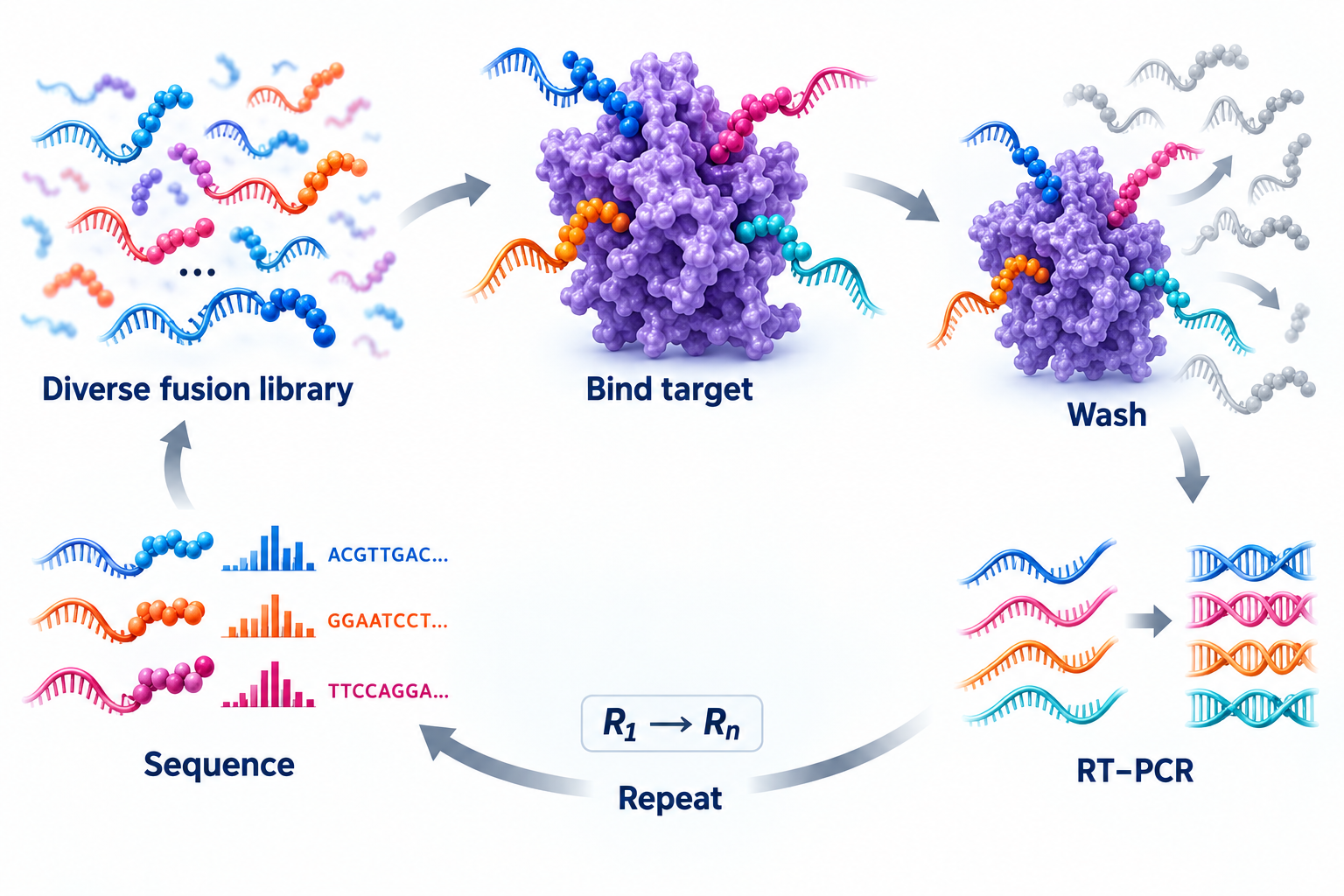
Figure 2. From an Ultra-Large Library to Enriched Sequences. Selection progressively concentrates reproducible binders; sequencing identifies enriched families rather than proving function by itself.
What Enrichment Does—and Does Not—Mean
Enrichment means that a sequence or family becomes more abundant under the applied selection conditions. It can reflect target binding, but it can also arise from amplification bias, nonspecific interactions, bead binding or unusually efficient translation and fusion formation. Appropriate negative selections, replicate campaigns and orthogonal assays are therefore important.
Sequencing counts help prioritize candidates and reveal sequence–activity relationships, but they are not direct affinity measurements. Selected peptides still require independent synthesis and experimental characterization, including binding, selectivity, functional activity, solubility and stability assays appropriate to the project.
From Linear Peptides to Cyclic Peptides
Linear peptides often sample many conformations in solution. Cyclization can reduce the accessible conformational space and may preorganize a peptide toward a binding-competent state. In suitable cases, this may improve affinity or selectivity and may reduce susceptibility to proteolysis. None of these outcomes is automatic: an incorrect ring topology can disrupt a binding conformation, introduce strain or complicate synthesis.
mRNA display can be paired with several cyclization strategies, provided that the chemistry is compatible with the library and preserves genotype–phenotype linkage. Ring size, anchor placement, side-chain orientation and target geometry remain design variables. For a practical discussion of those choices, see From Linear Peptides to Cyclic Peptides: When Is Cyclization Worthwhile?.
Why Noncanonical Amino Acids Matter
The 20 canonical amino acids provide a rich sequence space, but they do not span all of the chemistry useful for ligand discovery. Noncanonical amino acids can extend side-chain chemistry, stereochemistry and backbone chemistry; alter conformational preferences; introduce cyclization handles; and explore physicochemical or proteolytic-stability profiles that are inaccessible to canonical residues alone.
Relevant classes can include D-amino acids, N-methyl amino acids, α-substituted amino acids and residues with chemically diverse side chains. Their incorporation is system-dependent. Different building blocks require compatible aminoacylation, tRNA, codon assignment and translation conditions; no single charging strategy places every NCAA into every translation system without qualification.
Genetic-code reprogramming and engineered translation systems can therefore expand not only the number of sequences, but the chemical space accessible to selection. The value lies in controlled, experimentally supported incorporation—not in treating every conceivable monomer as freely interchangeable.
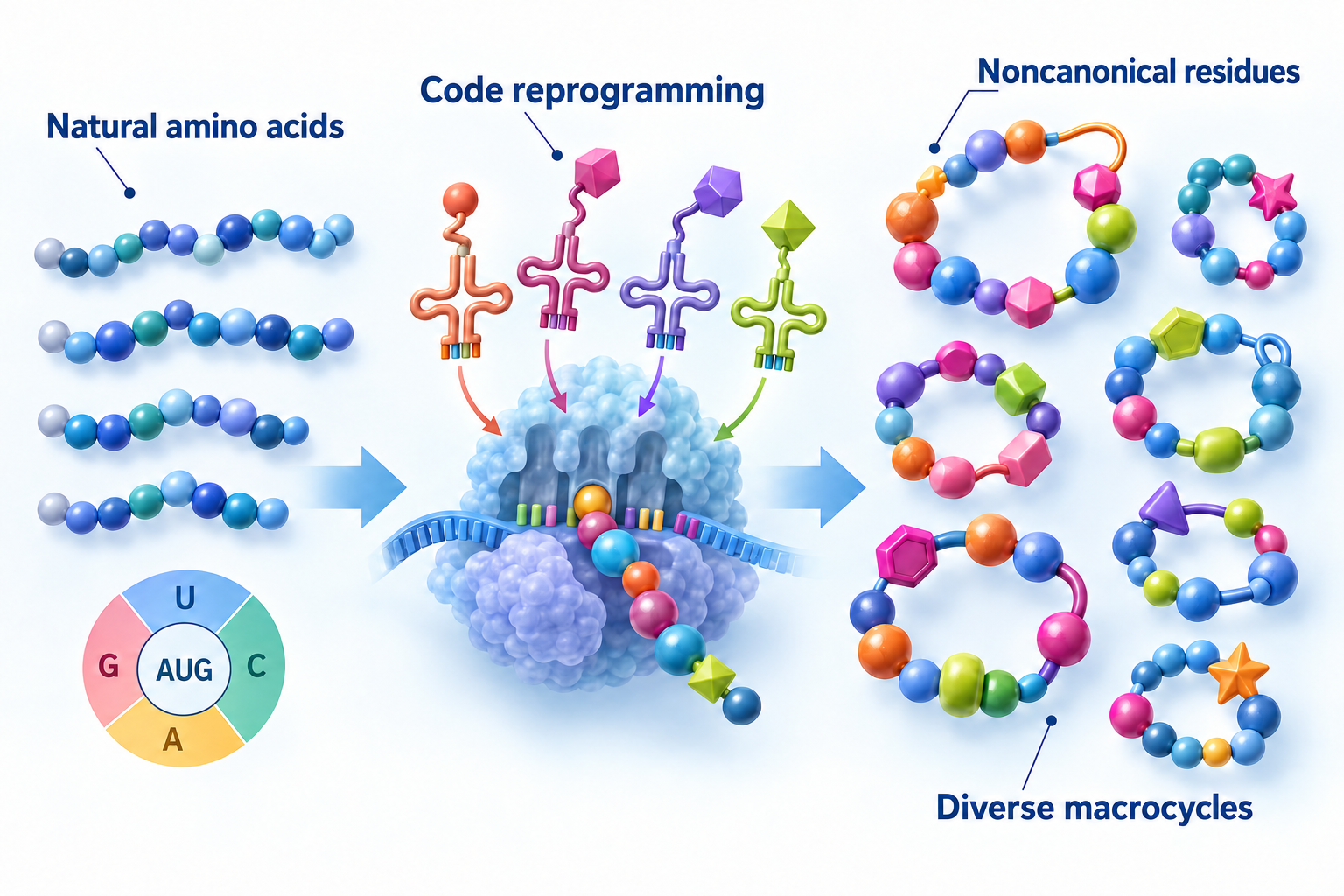
Figure 3. Expanding from Natural Sequence Space to Noncanonical Cyclic-Peptide Chemical Space. The expansion concerns residue chemistry, backbone and conformation as well as sequence diversity.
Additional design considerations for these building blocks are discussed in How Noncanonical Amino Acids Improve Peptide Design Beyond Stability and The Important Role of N-Methyl Amino Acids in Peptide Drugs.
How Can mRNA Display and AI Work Together?
An mRNA display campaign can produce more than a list of winners. Round-by-round sequencing, library composition, monomer identity, cyclization format and measured enrichment create a structured experimental dataset. When negative examples and assay metadata are retained, computational models can learn relationships among sequence, chemistry and selection behavior.
Such models may help cluster enriched families, identify motifs, estimate uncertainty, prioritize variants or propose candidates around experimentally supported regions of chemical space. Structure-based methods can add hypotheses about target contacts and conformational constraints, while generative models can suggest new sequences subject to explicit chemical and synthesis rules.
The useful workflow is a closed loop: experimental selection supplies data; a model prioritizes testable candidates; those candidates return to synthesis and experimental validation; and the results become new data. A model does not replace target selection, binding assays or developability testing, and enrichment data should not be treated as a universal activity label.
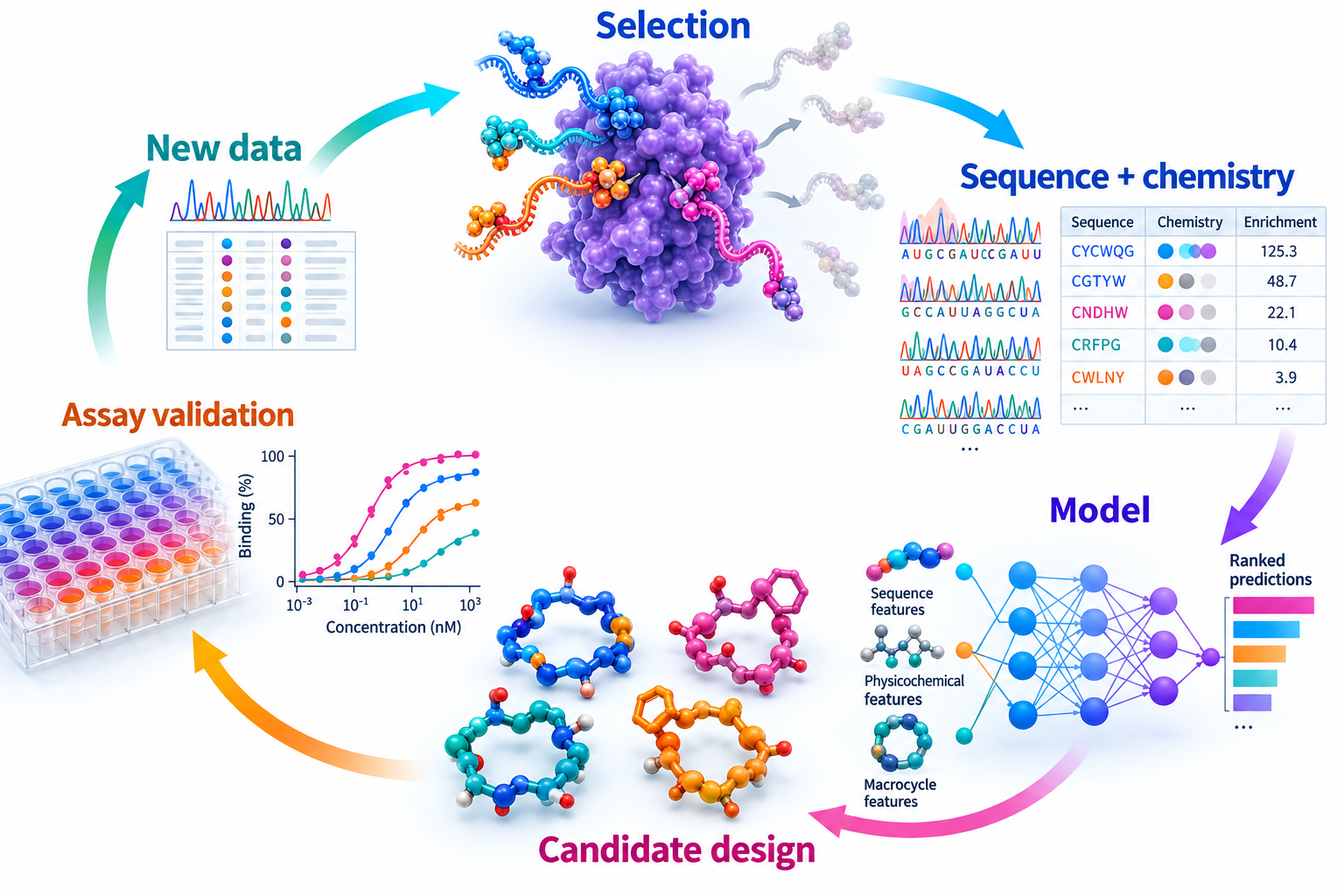
Figure 4. From Experimental Selection to a Data-Driven Design Loop. Models prioritize experimentally testable hypotheses; validated outcomes improve the next iteration.
This positioning complements AI-Assisted Peptide Design: From Sequence to Drug Candidates: computation is most useful when its inputs, chemical constraints and experimental endpoints are clearly defined.
Building a Useful Discovery Campaign
A robust campaign begins with the biological question rather than the nominal library size. Target state, immobilization strategy, counter-targets, wash stringency and recovery conditions should reflect the intended binding mode. The library must be compatible with the translation and cyclization chemistry, while sequencing and controls should make technical bias visible.
After selection, representative members from different enriched families—not only the most abundant read—should be synthesized independently. Orthogonal binding assays, competition experiments and functional tests can distinguish genuine target engagement from selection artifacts. If the objective is a developable lead, stability, solubility, selectivity and manufacturability must enter the program early; custom peptide and cyclic-peptide synthesis is the bridge from encoded hits to material that can be tested directly.
Conclusion
mRNA display joins a peptide to its own sequence identity through a puromycin-mediated covalent linkage. Its cell-free format supports exceptionally large libraries, while iterative selection and sequencing connect molecular behavior to recoverable genetic information. Cyclization and carefully implemented NCAA incorporation can extend the accessible chemical space beyond canonical linear peptides.
The technology is most powerful as an experimental platform: library design, selection controls, sequencing analysis, independent synthesis and validation all contribute to reliable discovery. Computational and generative methods can strengthen that process when they learn from well-annotated experimental data and return their proposals to the laboratory for testing.
Selected References
- Roberts RW, Szostak JW. RNA-peptide fusions for the in vitro selection of peptides and proteins. Proceedings of the National Academy of Sciences of the United States of America. 1997;94(23):12297–12302. doi:10.1073/pnas.94.23.12297
- Nemoto N, Miyamoto-Sato E, Husimi Y, Yanagawa H. In vitro virus: bonding of mRNA bearing puromycin at the 3′-terminal end to the C-terminal end of its encoded protein on the ribosome in vitro. FEBS Letters. 1997;414(2):405–408. doi:10.1016/S0014-5793(97)01026-0
- Wilson DS, Keefe AD, Szostak JW. The use of mRNA display to select high-affinity protein-binding peptides. Proceedings of the National Academy of Sciences of the United States of America. 2001;98(7):3750–3755. doi:10.1073/pnas.061028198
- Huang Y, Wiedmann MM, Suga H. RNA display methods for the discovery of bioactive macrocycles. Chemical Reviews. 2019;119(17):10360–10391. doi:10.1021/acs.chemrev.8b00430
- Peacock H, Suga H. Discovery of de novo macrocyclic peptides by messenger RNA display. Trends in Pharmacological Sciences. 2021;42(5):385–397. doi:10.1016/j.tips.2021.02.004
- Goto Y, Suga H. The RaPID platform for the discovery of pseudo-natural macrocyclic peptides. Accounts of Chemical Research. 2021;54(18):3604–3617. doi:10.1021/acs.accounts.1c00391
Next: Beyond the Natural Amino-Acid Alphabet — Expanding mRNA Display into Noncanonical Chemical Space