From an mRNA Display Hit to Enlicitide (3): Binding Well Is Not Enough
Compound 30 had a clear PCSK9 binding mode, but stability, PK, safety, and solubility remained unresolved. Structure-guided D-amino-acid substitution, bicyclization, and N-methylation advanced the series while revealing new developability liabilities.
From an mRNA Display Hit to Enlicitide (3): Binding Well Is Not Enough
From an mRNA Display Hit to Enlicitide · Part 3
Previous: Seeing How the Macrocycle Binds PCSK9 for the First Time
Compound 30 Was Not the Finish Line
In Part 2, researchers could finally see how Compound 30 bound PCSK9. For a drug-discovery program, that was an important breakthrough: potency was strong, the co-crystal structure was available, and the binding mode could be interpreted. But Compound 30 was still not a drug. It remained vulnerable to proteases and was cleared rapidly in vivo.
The question had therefore changed. The team no longer needed simply to find a macrocycle that recognized PCSK9. It needed to preserve that recognition while making the molecule stable enough—and broadly developable enough—to survive outside a binding assay. This is the point at which an excellent binder begins to encounter the less forgiving demands of drug design.
Binding and exposure describe different parts of a molecule's journey. An affinity measurement asks whether the peptide can engage its target under controlled conditions. A useful in-vivo molecule must first remain intact, reach the relevant compartment, avoid unacceptable biological responses, and persist at a sufficient concentration. Compound 30 had answered the first question compellingly; the rest of that journey remained open.
Protecting a Vulnerable Position with a D-Amino Acid
The crystal structure offered a practical clue. A glycine position could accommodate an added methyl group without forcing the target-facing region into a new arrangement. Replacing Gly with D-Ala produced Compound 40. It largely retained potency while becoming more resistant to degradation by elastase and trypsin.
A new crystal structure helped explain why the change worked. The D-Ala methyl group pointed toward solvent and did not disrupt the established binding mode. This was not a generic demonstration that D-amino acids make every peptide better. It was a specific solution to a specific design problem: protect a susceptible part of the peptide while disturbing target recognition as little as possible.
The stereochemical choice mattered. Simply adding a methyl group can alter backbone preferences as well as local steric demand. Here, the bound structure showed that the selected D-configuration placed the new group where it could be tolerated. Structural information did not replace the protease assays; it connected the measured improvement to a plausible molecular explanation and gave the team a firmer basis for the next design.
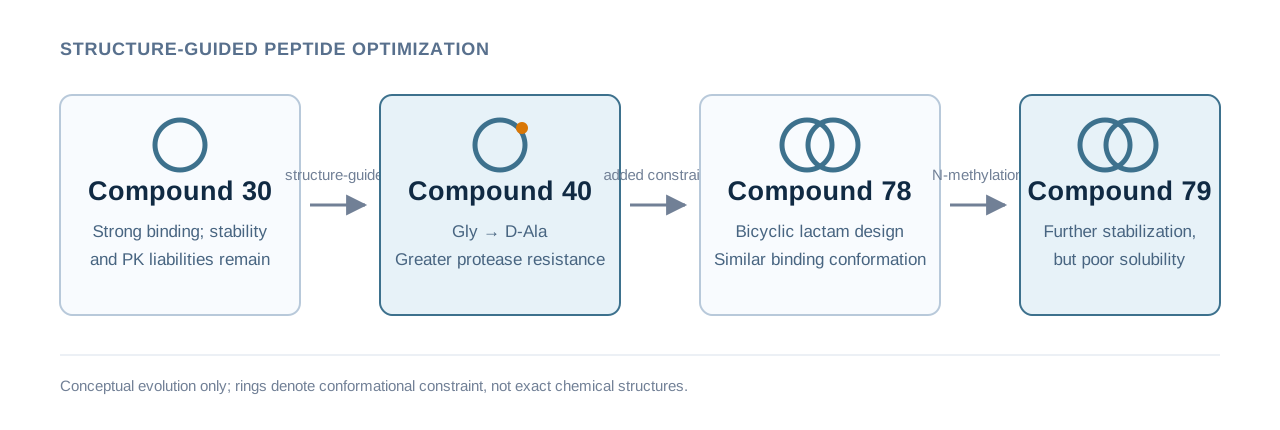
Figure 1. The optimization path followed in this article. This is a conceptual evolution diagram based on the design steps reported by Alleyne et al.; the ring symbols indicate increasing conformational constraint and are not chemical structures. Compound 79 achieved further protease stabilization but introduced poor solubility, so it was not the endpoint of the program.
Solving One Problem Revealed Another
The researchers continued to use structural information to rebuild local backbone geometry around protease-sensitive regions. Changes in the Pro–Thr region and related designs could markedly improve stability in in-vitro protease assays. Yet animal pharmacokinetics did not improve in parallel. A molecule can resist a selected enzyme assay and still be cleared through other pathways, distribute unfavorably, or encounter liabilities that the assay was never designed to measure.
Another problem emerged in basic analogues containing Lys: mast-cell degranulation. The relevant side chain occupied a solvent-exposed position, giving the team room to change its chemistry without redesigning the core PCSK9 interface. Adjusting that position reduced the liability, but the episode made the optimization problem wider. Potency, protease stability, pharmacokinetics, and safety-related behavior had to be considered together; success against one readout could not compensate for failure elsewhere.
This pattern—an improvement uncovering the next limitation—is characteristic of multi-parameter optimization. It does not mean that the earlier change failed. Rather, once one dominant weakness is reduced, a previously secondary property can become the new constraint. Progress is therefore measured not by maximizing a single assay result, but by gradually narrowing the set of unresolved liabilities without losing the properties already earned.
From One Ring to Two
The structure also revealed an opportunity that was difficult to infer from sequence alone. Two regions separated along the peptide chain sat close together in three dimensions. Connecting them through a second cyclization could further restrict the conformational ensemble, potentially shielding the backbone while preserving the shape recognized by PCSK9.
Compound 78 implemented this idea as a bicyclic lactam. Its crystal structure remained highly similar to that of Compound 30, showing that the added ring could constrain the peptide without replacing its original binding mode. This was an important result: the second cycle was not merely decorative chemistry, but a way to reinforce a productive three-dimensional arrangement.
The comparison also illustrates why bicyclization must be guided rather than applied indiscriminately. A new covalent connection can stabilize a useful conformation, but it can just as easily trap the wrong one or distort target contacts. In Compound 78, the proximity observed in three dimensions identified a connection compatible with the known bound state; the subsequent structure then tested that design assumption directly.
One amide still remained exposed. N-methylation at that site produced Compound 79 and substantially increased protease stability. Yet the improvement came with a new cost—poor solubility. Compound 79 was therefore not a successful final candidate and should not be read as MK-0616 or as its direct precursor. It was another informative design point: stronger conformational and metabolic protection had been achieved, but the overall property balance was still incomplete.
Where Drug Design Becomes Difficult
The journey from Compound 30 to Compounds 40, 78, and 79 shows how different technologies contribute without solving the whole problem alone. mRNA display can supply a high-quality starting point against a difficult protein surface. Structure-based design can distinguish positions that participate in recognition from those with room for modification. D-amino acids, N-methylation, and additional cyclization can then reshape stability and conformational behavior with unusual precision.
A real drug, however, must occupy a much narrower intersection. Binding must coexist with protease and metabolic stability, useful pharmacokinetics, adequate solubility, an acceptable safety profile, and—if oral dosing is the goal—permeability and exposure. The 2020 study established a foundation for later oral PCSK9 cyclic-peptide development; it did not yet report enlicitide or solve oral bioavailability.
Solubility is a useful reminder of how tightly these properties are coupled. Changes that rigidify a peptide or shield backbone amides may improve stability, yet can also alter hydration, aggregation, and the concentration that can be achieved in solution. The desirable molecular features do not simply accumulate; they must coexist in the same structure and under the same dosing conditions.
Even after these advances, one harder question remained: how could a macrocyclic peptide, far larger than a conventional small molecule, become orally available?
Series: Part 1: The Story Begins with a Screen | Part 2: Seeing How the Macrocycle Binds PCSK9 | Part 3 | Part 4: How a Macrocyclic Peptide Begins to Become an Oral Drug | Peptide Drugs
Scientific Source and Related Reading
Alleyne C, Amin RP, Bhatt B, et al. Series of Novel and Highly Potent Cyclic Peptide PCSK9 Inhibitors Derived from an mRNA Display Screen and Optimized via Structure-Based Design. Journal of Medicinal Chemistry. 2020;63(22):13796–13824. https://doi.org/10.1021/acs.jmedchem.0c01084
Related services and resources: mRNA display technical resources | AI peptide design | custom peptide synthesis
Have a potent macrocycle that now needs stability and developability optimization?
Apollomics supports custom synthesis, structural confirmation, and multi-parameter developability testing for noncanonical macrocycles, helping teams turn structural hypotheses into testable molecules.