How to Improve Peptide Stability: Sequence, Half-Life, and Formulation
Peptide instability may arise from proteolysis, rapid clearance, uncontrolled release, or storage degradation. Locating the failure first determines whether to redesign the sequence, extend half-life, or change the formulation.
Three apparently contradictory reports can arrive for the same peptide candidate. One peptide retains its purity for months as a lyophilized product but is rapidly cleaved after entering plasma. Another remains intact in plasma yet disappears quickly from the circulation after injection. A third achieves prolonged exposure through a delivery system but aggregates after reconstitution.
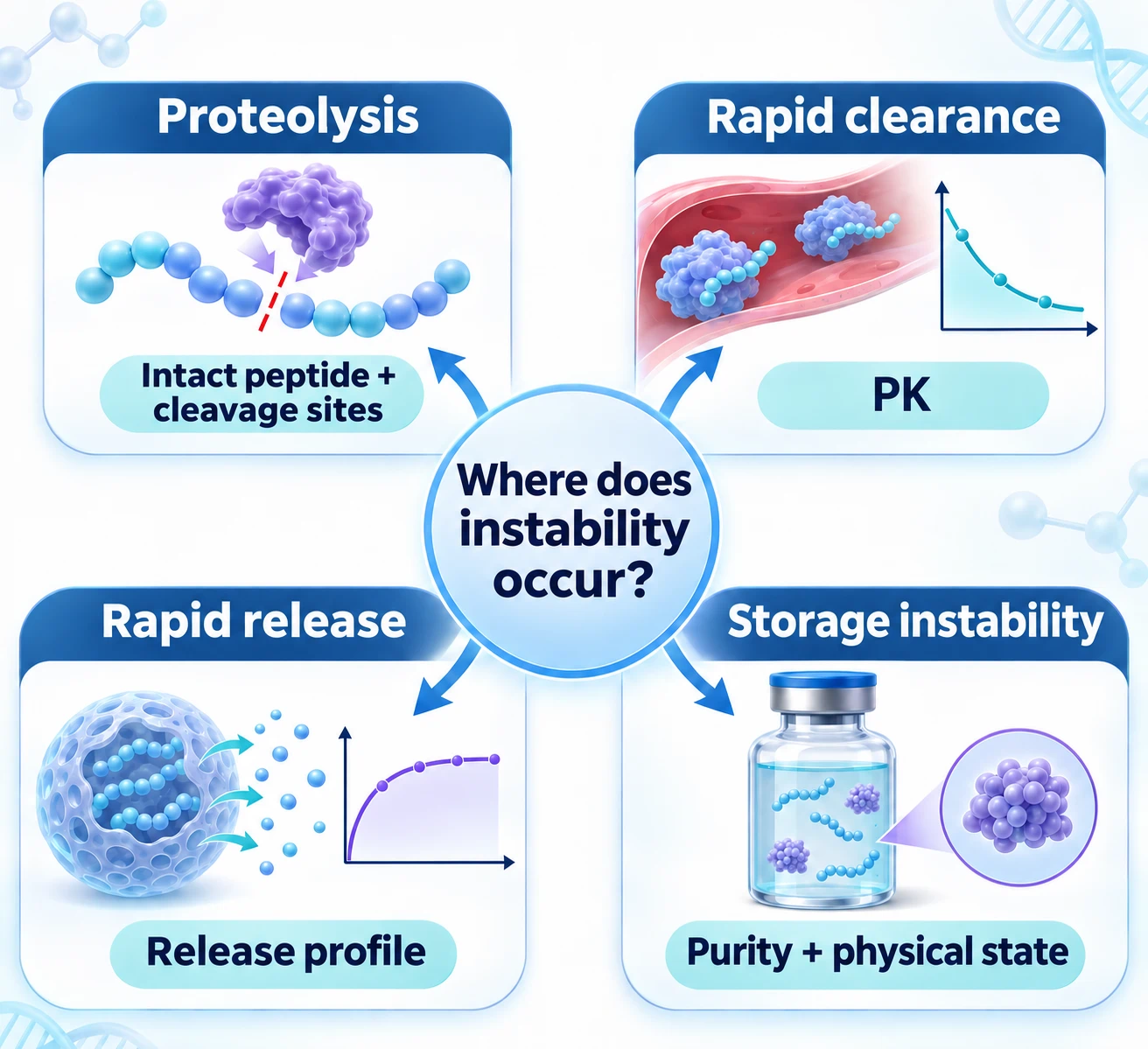
These scenarios are illustrative, but they point to a real development mistake: “instability” is not a single property. It includes at least four independently testable questions. Is the intact peptide being cleaved? Is it cleared too quickly from the circulation? Does the formulation release it at the required rate? Does chemical or physical change occur during storage or use? The location of the problem determines whether the answer lies in the sequence, molecular size, delivery system, or formulation.
When the Intact Peptide Is Cleaved, Locate the Cut First
The decline of the parent peptide during plasma incubation answers how long the intact molecule remains. LC–MS localization of degradation products answers a different question: where is it cut? The first measurement supports an overall stability comparison; the second makes it possible to direct sequence engineering toward a specific cleavage site. If only the parent peak is known to decline, making the whole sequence more hydrophobic or rigid may simply exchange proteolysis for poor solubility or lost activity.
Terminal capping can reduce access by exopeptidases acting from a free N or C terminus. Head-to-tail cyclization removes both free termini. Side-chain cyclization and bicyclization do not necessarily do so; whether the termini remain depends on the topology. D-amino acids or noncanonical residues, Aib (alpha-aminoisobutyric acid), backbone N-methylation, and peptide-bond mimetics are better evaluated residue by residue around a confirmed cleavage site and local backbone. N-methylation changes substitution and hydrogen-bond donation at the amide nitrogen; it does not remove the amide bond itself. When activity depends on an alpha-helical interface, hydrocarbon stapling provides a more targeted conformational constraint. Any constraint, however, can change side-chain orientation, affinity, solubility, and synthetic feasibility.
Semaglutide illustrates this problem-directed approach. Ala at position 8 was replaced with Aib to increase resistance to DPP-4 degradation. This modification addresses proteolysis; it does not by itself explain once-weekly dosing. Both the discovery paper by Lau and colleagues and the FDA WEGOVY label distinguish position-8 stabilization from the half-life-extension mechanism described below. For a related example of how cyclization topology can improve stability while preserving activity, see From an mRNA Display Hit to Zilucoplan (2).
When the Intact Peptide Remains but Exposure Is Short, Investigate Clearance
If an intact peptide performs well in an in-vitro plasma assay but systemic exposure remains short, pharmacokinetic evidence should be used to evaluate renal clearance, tissue distribution, and other elimination routes. The answer is not automatically another unidentified protease site. In-vitro intact-peptide half-life in plasma, in-vivo circulation half-life, and duration of pharmacological effect are three different endpoints; one cannot be used to infer the other two directly.
Semaglutide's second key design is at Lys26. A C18 fatty di-acid is attached through a spacer to promote reversible albumin binding and reduce clearance. The same molecule therefore uses Aib at position 8 to address proteolysis and lipidation at position 26 to address systemic exposure. Lipidation commonly extends action through albumin binding, whereas PEG conjugation primarily reduces renal clearance by increasing hydrodynamic size. Albumin-binding groups, Fc fusion, and albumin fusion are additional options, but each changes molecular size, free fraction, or tissue distribution and must be evaluated in its actual configuration rather than by nominal molecular weight alone.
For oral delivery, the question must be divided again. Resistance to gastrointestinal degradation and transport across the epithelium require separate validation. Remaining intact in simulated gastrointestinal fluid does not show that a peptide can cross the epithelium, and improved absorption does not prove that the absorbed material is intact and active. The interaction between molecular engineering and an absorption enhancer is discussed further in From an mRNA Display Hit to Enlicitide (5).
To Prolong Release After Dosing, Change the Rate of Entry into the Circulation
Once the candidate's activity and intrinsic in-vivo pharmacokinetics are reasonably defined, a delivery system can become the principal variable for reducing dosing frequency. In SANDOSTATIN LAR DEPOT, octreotide is distributed in biodegradable polymer microspheres. Polymer hydrolysis controls the rate at which drug leaves the injection site and enters the circulation. The FDA label also states that once octreotide reaches the systemic circulation, it distributes and is eliminated according to its known pharmacokinetic properties. A long-acting microsphere formulation therefore prolongs the input process; it does not permanently slow octreotide's intrinsic clearance.
Nanoparticles, liposomes, and in-situ-forming gels can also alter local retention and release, but evaluation cannot stop at an attractive release curve. Encapsulation consistency, initial burst, the integrity and activity of the released peptide, and compatibility between the carrier and drug during storage can all determine the final exposure. Without direct evidence for a specific product, a carrier should not be described as completely preventing proteolysis or immune clearance.
When Instability Occurs in the Vial or After Reconstitution, Formulate for the Mechanism
Storage stability includes both chemical and physical change. Oxidation of Met or Trp may call for control of oxygen, peroxide impurities, and light. Asn deamidation and peptide-bond hydrolysis are often sensitive to pH, buffer species, and temperature. Aggregation and container adsorption additionally depend on concentration, interfaces, agitation, and container material. A generic instruction to add a stabilizer cannot address every mechanism and may suppress one pathway while accelerating another.
Lyophilization can slow many reactions by reducing available water, but it is not the endpoint of stability development. Trehalose is commonly used as a lyoprotectant, while mannitol is commonly used as a bulking agent. The formulation must still be assessed for freezing and drying stress, residual moisture, cake properties, and stability after reconstitution. Low-oxygen packaging or light protection can be evaluated for a defined oxidation risk. Container, stopper, and surfactant compatibility should be compared when adsorption is a concern. The pH, buffer, temperature, and packaging of a liquid formulation should be selected from the measured degradation profile of the candidate. Shelf-life studies should at minimum follow assay, impurities, and applicable physical attributes, with functional activity checked when necessary. Practical considerations for reconstitution and aggregation are covered in How Does Peptide Sequence Affect Solubility?.
The next development decision should not ask only whether half-life increased. Intact peptide, target activity, and the exposure required for efficacy need to be considered together. If a modification substantially reduces proteolysis but also weakens binding, the team should return to the LC–MS-defined cleavage site and binding interface and choose a different position rather than stacking on more modifications. Identifying where instability occurs is often more useful than adding more stability technologies.
References
- Lau J, Bloch P, Schäffer L, et al. Discovery of the Once-Weekly Glucagon-Like Peptide-1 (GLP-1) Analogue Semaglutide. Journal of Medicinal Chemistry. 2015;58(18):7370–7380. https://doi.org/10.1021/acs.jmedchem.5b00726
- U.S. Food and Drug Administration. WEGOVY (semaglutide) Prescribing Information. 2025. FDA label
- U.S. Food and Drug Administration. SANDOSTATIN LAR DEPOT (octreotide acetate) Prescribing Information. 2024. FDA label
- Nugrahadi PP, Hinrichs WLJ, Frijlink HW, Schöneich C, Avanti C. Designing Formulation Strategies for Enhanced Stability of Therapeutic Peptides in Aqueous Solutions: A Review. Pharmaceutics. 2023;15(3):935. https://doi.org/10.3390/pharmaceutics15030935
- Bak A, Leung D, Barrett SE, et al. Physicochemical and Formulation Developability Assessment for Therapeutic Peptide Delivery—A Primer. The AAPS Journal. 2015;17:144–155. https://doi.org/10.1208/s12248-014-9688-2