Oral Cyclic Peptide Developability: From Structural Change to Systemic Exposure
Moving one N-methyl group can lower cyclic-peptide permeability, and permeability alone does not ensure oral exposure. Connect structure, in-vitro assays, and pharmacokinetics to the next design decision.
A cyclic peptide already inhibits its target, and the next goal is oral dosing. Which analogues should be synthesized first? Backbone N-methylation is an attractive starting point because it removes an amide hydrogen-bond donor. Yet the modification can also reshape the entire ring. In a model cyclic hexapeptide series, moving just one N-methyl group was enough to lower passive membrane permeability. More importantly, improving an artificial-membrane result is not the same as achieving useful systemic exposure after an oral dose.
Why can the same three N-methyl groups give different permeability?
White and colleagues compared two cyclic hexapeptides with the same amino-acid sequence, stereochemistry, and number of backbone N-methyl groups. The structures below label them compound 1 and compound 2. Their shared ring sequence is cyclo[L-Leu¹–D-Leu²–L-Leu³–L-Leu⁴–D-Pro⁵–L-Tyr⁶]. Compound 1 is N-methylated at D-Leu², L-Leu³, and L-Tyr⁶; compound 2 is N-methylated at L-Leu¹, D-Leu², and L-Tyr⁶. Thus, one methyl group moves from L-Leu³ to L-Leu¹. The structures show connectivity and methylation sites, not measured three-dimensional conformations.
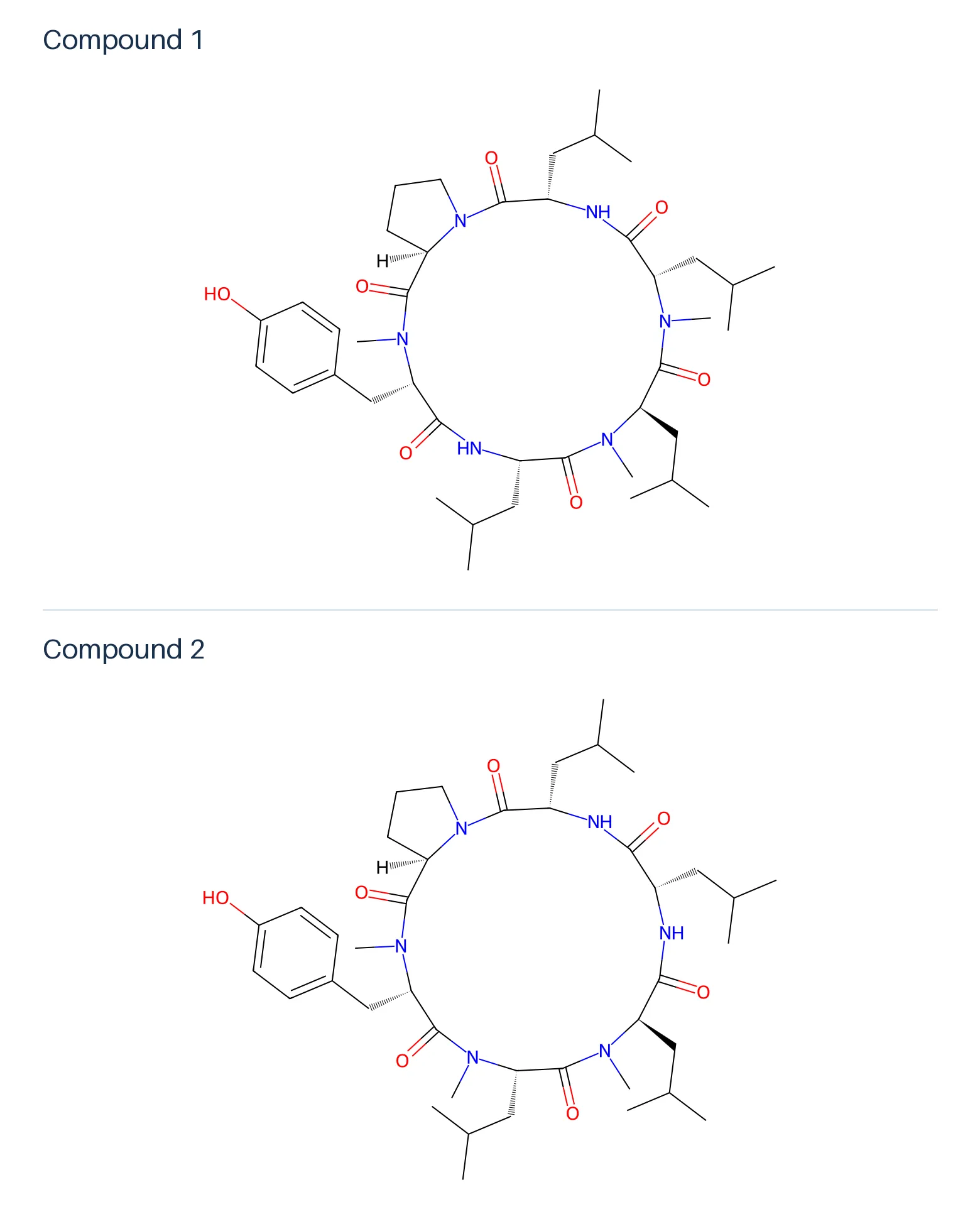
In compound 1, the two remaining amide NH groups are protected in intramolecular hydrogen bonds; both had hydrogen–deuterium exchange half-lives longer than 24 hours under the reported conditions. In compound 2, one NH exchanged completely within three minutes and the other had a half-life of about two hours. These observations support a difference in solvent exposure, rather than a simple rule that more methylation means more permeability.
In the parallel artificial membrane permeability assay (PAMPA) used by White and colleagues, compound 2 gave a 5.7 ± 0.9% transfer value, while compound 1 was more permeable. The paper defines this endpoint as the proportion reaching the acceptor compartment after 16 hours, with 100% corresponding to donor–acceptor equilibrium. It is neither a Caco-2 permeability coefficient nor an oral bioavailability value. The key design lesson is the regioisomer comparison: methylation position changes the geometry and the polarity the molecule presents to its surroundings.
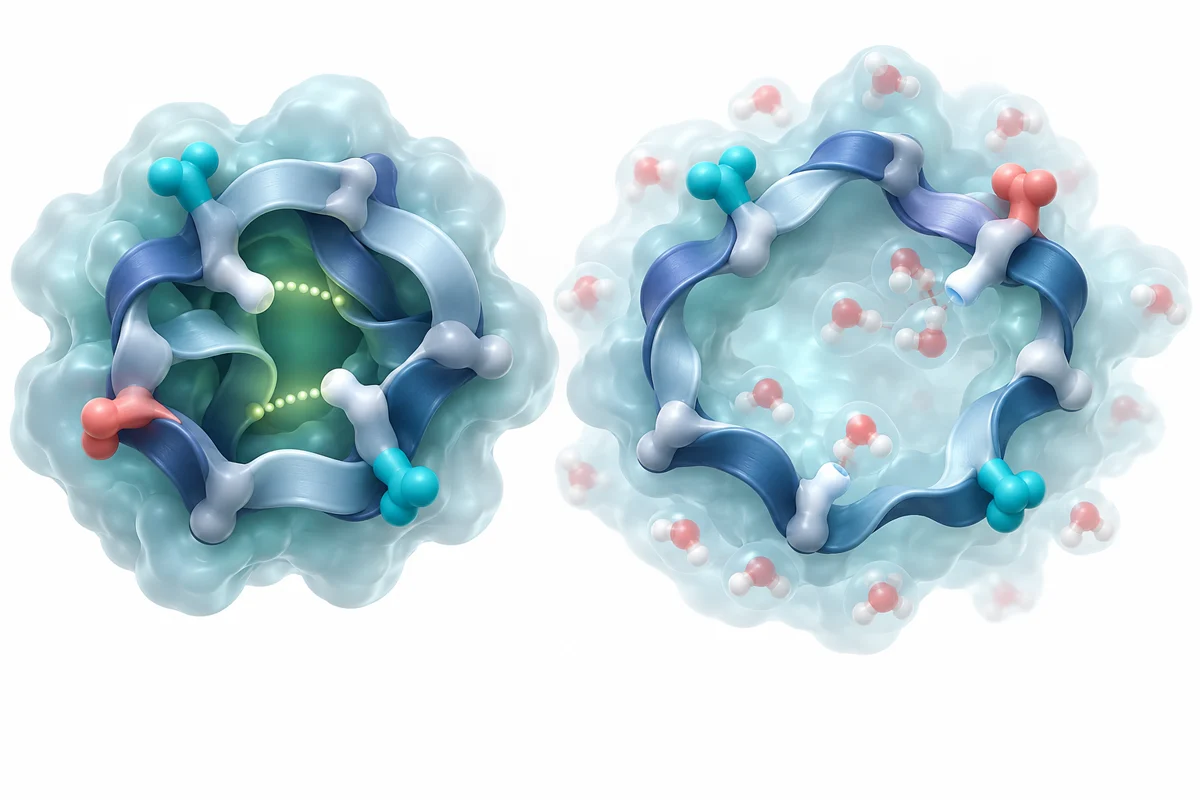
For a cyclized lead whose early data point to a permeability limitation, one useful hypothesis is to examine NH groups that are frequently solvent-exposed but are not clearly required for target recognition. If an NH may participate in binding, a neighboring side chain that shields it may be a better first test than deleting the donor. A single stereochemical change can also be tested when local turns appear to govern exposure. Keeping the parent and making a small set of single-site analogues makes changes in activity and permeability easier to attribute. A docking pose alone does not establish that an NH is dispensable.
An artificial membrane is only one barrier
PAMPA evaluates passive diffusion across an artificial lipid membrane. Caco-2 measures apparent transport across a cell monolayer and can also reflect paracellular passage, transporters, and efflux. Ovadia and colleagues studied a cyclic hexapeptide library in which some compounds were highly permeable in Caco-2 despite little artificial-membrane permeability. Marelli and colleagues later observed enantiomer pairs with similar PAMPA results but different Caco-2 transport, evidence consistent with a carrier-mediated contribution. A discordant ranking is therefore a reason to examine the assay and mechanism, not proof that a particular transporter is involved. Check dissolved donor concentration, intact-peptide recovery, and monolayer integrity before pursuing transport mechanisms.
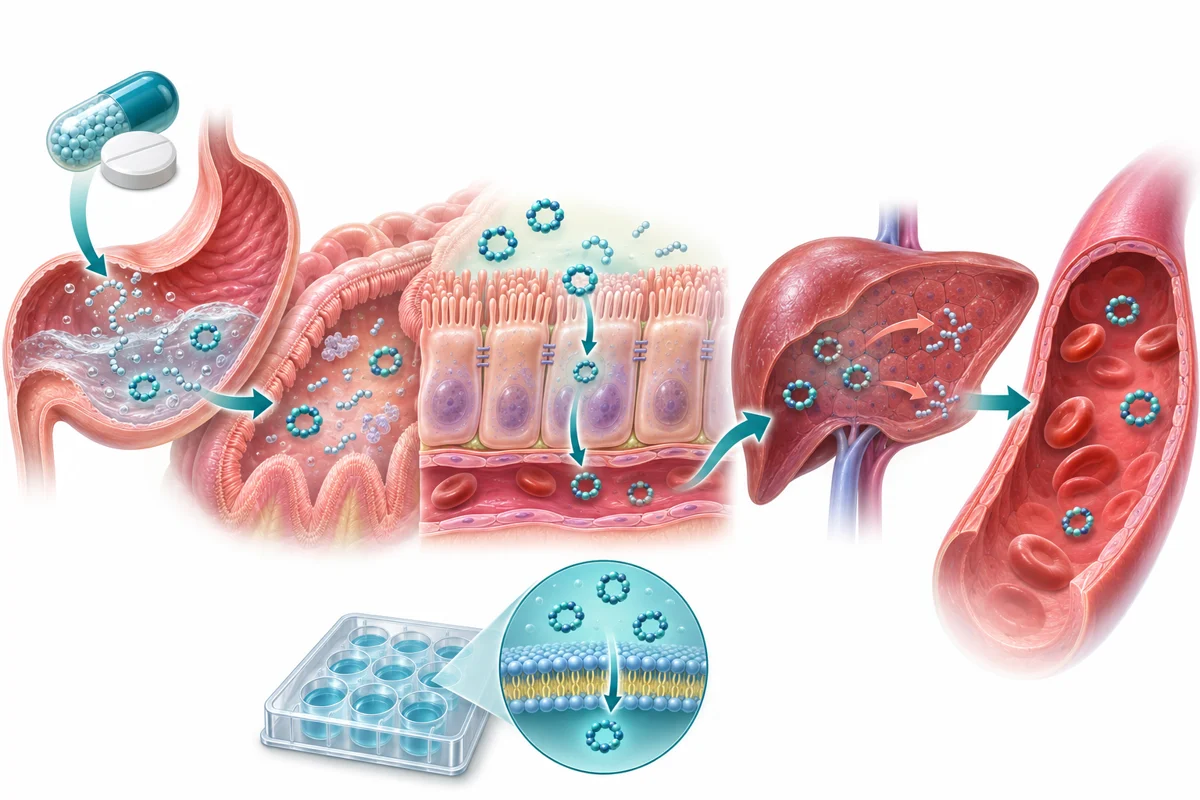
Before the epithelium, another question matters: how much intact peptide can reach it? A modification that increases passive permeability may still reduce the dissolved fraction or make the peptide more vulnerable to digestive enzymes. Merz and colleagues used iterative synthesis and screening of thrombin-binding cyclic peptides, evaluating activity alongside stability in simulated gastric and intestinal fluids, PAMPA permeability, and rat-liver-microsome stability. After further optimization, their peptide 46 reached an absolute oral bioavailability of 18.4 ± 1.9% in rats. In the reported pharmacokinetic comparison, the oral dose was 10 mg/kg and the intravenous dose was 1 mg/kg. This is a result for a specific candidate and study, not a general expectation for cyclic peptides.
Which measurements should determine the next modification?
A first round can compare the parent and single-site analogues for functional potency, solubility, gastrointestinal stability, and passive permeability under matched conditions. If intact peptide disappears quickly in simulated gastrointestinal media, map degradation products before adding further permeability modifications. If the peptide remains intact but permeability is low, compare N-methyl positions, side-chain shielding, and conformational changes while retaining the activity assay as a counterweight. When PAMPA and Caco-2 disagree, verify recovery and assay quality before interpreting the difference mechanistically.
If improved in-vitro properties still do not produce oral exposure, paired oral and intravenous pharmacokinetics can estimate absolute bioavailability: F = (oral AUC / oral dose) / (intravenous AUC / intravenous dose), provided exposure is measured under comparable conditions and the relevant dose range is interpretable. The oral–IV comparison also informs systemic clearance, but a low F value alone cannot separate incomplete absorption from intestinal or hepatic first-pass loss. Formulation experiments, metabolite measurements, and other targeted studies may be needed to locate the bottleneck.
The final question is pharmacological: at an acceptable dose, does the concentration of intact active peptide reach and remain near the level needed for efficacy? The site's icotrokinra case study illustrates a different balance. Its absorption remains limited, yet high target potency and the administered dose allow measurable systemic exposure to translate into efficacy. Cyclosporine A offers an earlier natural example, but neither molecule is a universal template. For an early lead, the first synthesis round should identify one change that eases the present bottleneck without sacrificing target activity, then use that result to choose the next experiment.
References
- White TR, Renzelman CM, Rand AC, et al. On-resin N-methylation of cyclic peptides for discovery of orally bioavailable scaffolds. Nature Chemical Biology. 2011;7:810–817. https://doi.org/10.1038/nchembio.664
- Ovadia O, Greenberg S, Chatterjee J, et al. The Effect of Multiple N-Methylation on Intestinal Permeability of Cyclic Hexapeptides. Molecular Pharmaceutics. 2011;8:479–487. https://doi.org/10.1021/mp1003306
- Marelli UK, Bezençon J, Puig E, et al. Enantiomeric cyclic peptides with different Caco-2 permeability suggest carrier-mediated transport. Chemistry—A European Journal. 2015;21:8023–8027. https://doi.org/10.1002/chem.201501270
- Merz ML, Habeshian S, Li B, et al. De novo development of small cyclic peptides that are orally bioavailable. Nature Chemical Biology. 2024;20:624–633. https://doi.org/10.1038/s41589-023-01496-y
- Räder AFB, Weinmüller M, Reichart F, et al. Orally Active Peptides: Is There a Magic Bullet? Angewandte Chemie International Edition. 2018;57:14414–14438. https://doi.org/10.1002/anie.201807298