Peptide Developability: How Should Immunogenicity and Safety Be Evaluated?
Adequate activity and pharmacokinetics do not settle immunogenicity risk. Connect molecular and product-quality evidence, fit-for-purpose ADA assays, and longitudinal clinical outcomes.
Imagine a peptide candidate with adequate target activity and encouraging initial pharmacokinetics. Later, some participants test positive for anti-drug antibodies (ADAs), while exposure changes in others. An ADA result alone cannot establish that the antibodies caused a loss of exposure or a safety event. Interpretation needs three streams of evidence on the same timeline: immune-assay results, product-quality data, and longitudinal clinical observations. Immunogenicity risk should be considered during candidate selection and process development, not postponed until the end. The “last hurdle” in the title means a question that still matters after activity and pharmacokinetics look promising.
Which signals warrant investigation?
The first set of questions concerns the molecule. Sequence similarity to an endogenous peptide or protein raises a specific question: could a treatment-induced antibody also recognize the body's counterpart? Cyclization, backbone changes, and noncanonical residues may change the immune response, but none is proof of low immunogenicity. Risk depends on the particular molecule, its context of use, and the product actually administered.
The second set concerns formulation and manufacturing. Soluble aggregates, subvisible particles, truncated or deletion peptides, oxidized or deamidated species, and process residuals are different observations that require different investigations. RP-HPLC and LC–MS can help locate chemical variants; when suitable for the formulation and size range, size-exclusion chromatography and particle methods address other classes. A clean purity chromatogram does not rule out aggregates, particles, or a clinical immune response. Conversely, finding an impurity alongside ADA does not show that the impurity caused the ADA. Compare batches, stability conditions, and exposure histories before assigning a mechanism.
The third set concerns use in patients: route, frequency and duration of dosing, disease state, concomitant medication, and patient background. These factors should be assessed for the intended product and population rather than converted into a universal ranking of administration routes. The FDA's December 2023 Clinical Pharmacology Considerations for Peptide Drug Products remains a draft, not an implemented requirement. It describes a product-specific risk assessment spanning molecular, process, patient, and dosing factors.
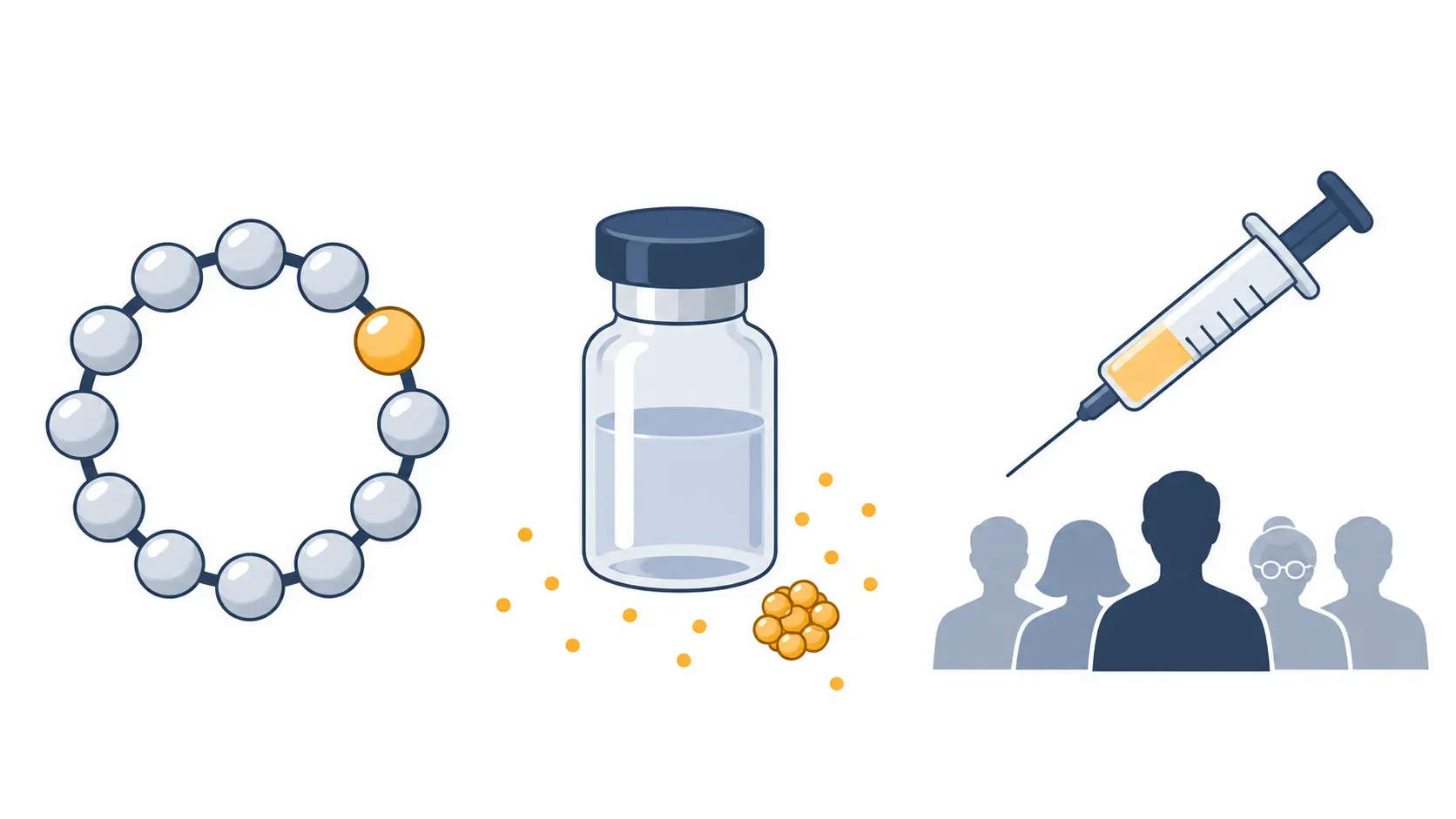
Which evidence is useful at each development stage?
During candidate and process selection, characterize the intended molecular species and follow degradation, aggregation, particle formation, and batch consistency under relevant handling and storage conditions. The goal is to identify and control plausible risks before treating a later clinical signal as a mystery. In nonclinical studies, an ADA assay can help interpret unexpected animal exposure or toxicology when fit for that study; animal ADA incidence is not a direct forecast of human incidence.
In clinical studies, an ADA is an antibody that binds the administered drug. A risk-appropriate testing strategy commonly begins with a sensitive screen, confirms specificity, and estimates titer for confirmed positives. Titer is a semi-quantitative result within a defined assay, not a universal concentration. Neutralizing antibody (NAb) activity is a separate functional question, evaluated when justified by product risk and study objectives. The FDA's February 2019 final assay guidance sets out this tiered methodological framework for therapeutic protein products and states that it may apply to some peptides case by case; it is not a uniform rule for every peptide project. Sensitivity, tolerance to circulating drug, matrix interference, and sampling time all affect whether results can be compared and interpreted.
Chen and colleagues (2025) compared several ADA assay formats for one therapeutic peptide. In their tested conditions, a direct-binding format using labeled protein A/G met the desired sensitivity and drug tolerance for a nonclinical use; a bridging format had lower assay variability than the affinity-capture-elution format they compared and was suitable for their clinical-study purpose. The study illustrates fit-for-purpose selection, not a general winner among formats or a result transferable without validation to another peptide.
What does a positive ADA result mean for a patient?
Start with a pre-dose baseline. Then ask whether binding is treatment-emergent or increased from baseline, whether the titer is transient or persistent, and whether neutralizing activity is present. Place those results beside time-matched drug concentrations, pharmacodynamic markers, efficacy, and adverse events. A binding ADA, a functional NAb, and a hypersensitivity event are not interchangeable findings. Where an endogenous counterpart exists and the clinical concern is relevant, consider whether cross-reactivity or cross-neutralization needs to be assessed.
Two hypothetical patterns show why context matters. A one-time low-titer result with no contemporaneous change in exposure, response, or safety does not by itself establish clinical harm. Persistent or rising ADA together with lower exposure or weaker response deserves closer investigation, but temporal association is not proof of causation: drug in the sample can interfere with ADA detection, while dose changes, adherence, disease changes, and analytical variation offer other explanations. Compare individuals before and after ADA onset as well as groups, using a sampling schedule that can resolve the sequence of events. Do not treat an ADA-positive percentage as a standalone risk grade or compare percentages across trials that used different assays, sampling schemes, and populations.

The development decision is made from a shared timeline of molecular and batch characterization, assay performance and results, pharmacokinetics, response, and safety events—not from a single positive tube. Population-level risk and an individual patient's result answer different questions. Broader toxicology and safety pharmacology require their own assessment. For adjacent developability questions, see oral cyclic-peptide exposure and interpreting plasma-stability LC–MS data.
References
- U.S. FDA. Clinical Pharmacology Considerations for Peptide Drug Products. Draft guidance, December 2023; checked November 2026. FDA guidance page
- U.S. FDA. Immunogenicity Testing of Therapeutic Protein Products—Developing and Validating Assays for Anti-Drug Antibody Detection. Final guidance, February 2019. FDA guidance page
- U.S. FDA. Immunogenicity Assessment for Therapeutic Protein Products. Final guidance, August 2014. FDA guidance page
- Chen F, He X, Mao Y, Coble K. Method development for the detection of anti-drug antibodies against a therapeutic peptide: assay format selection. Bioanalysis. 2025;17(8):537–548. https://doi.org/10.1080/17576180.2025.2501937