From an mRNA Display Hit to Zilucoplan (1): Two Screening Hits, Two Different Clues
An mRNA display campaign for C5 inhibitors found a more potent linear peptide and a somewhat less potent but directly cyclizable peptide. Each supplied a different clue at the start of zilucoplan discovery.
From an mRNA Display Hit to Zilucoplan · Part 1
A Validated Target in Need of the Right Molecule
In 2023, the U.S. FDA approved zilucoplan (brand name Zilbrysq) for adults with anti-acetylcholine receptor antibody-positive generalized myasthenia gravis. It is a synthetic macrocyclic peptide administered by daily subcutaneous injection. Looking back today, the program has already reached approval. At the beginning of discovery, however, the team's question was much more specific: could they find a peptide that inhibited complement protein C5 and offered a credible starting point for further optimization?
In myasthenia gravis, antibodies disrupt signaling at the neuromuscular junction. They can also activate complement. Cleavage of C5 produces C5a and C5b: C5a participates in inflammatory signaling, while C5b initiates assembly of the membrane attack complex, contributing further damage at the neuromuscular junction. Blocking C5 therefore offers a way to interrupt a key segment of complement-mediated injury.
mRNA Display Revealed Two Different Starting Points
mRNA display links a peptide to the mRNA that encodes it. Researchers expose a very large collection of peptides to a target, retain molecules that bind or function, and use the attached nucleic-acid information to recover their sequences. A screen therefore yields more than an active sample: it produces molecular leads that can be resynthesized and studied. For a fuller introduction, see why mRNA display is particularly useful for noncanonical-amino-acid and cyclic-peptide discovery and what happens during a round of mRNA display selection.
Screens of two different mRNA libraries produced distinct hit series. Compound 1 was a 13-amino-acid linear peptide with an IC₅₀ of 12 nM in a red-blood-cell (RBC) lysis assay. Its sequence already contained noncanonical or modified residues, including norvaline (Nvl), tert-leucine (Tle), azatryptophan (AzaTrp), and phenylglycine (Phg). Compound 2 was somewhat less potent, with an RBC lysis IC₅₀ of 27 nM, but it contained two cysteines that could be directly cyclized with a xylene-derived linker. One hit supplied stronger functional activity; the other supplied an immediately actionable cyclization clue.
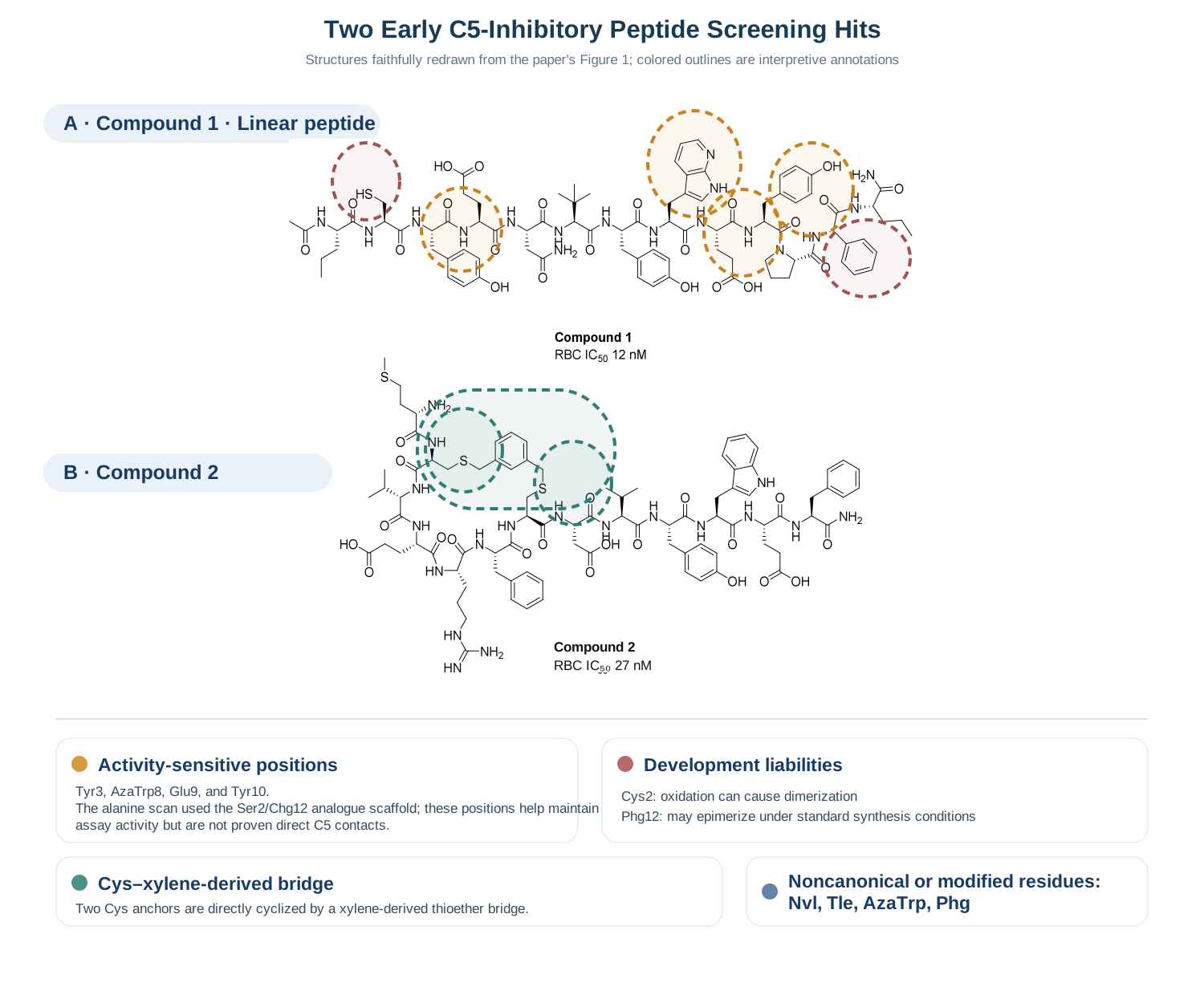
Figure 1. Two early C5-inhibitory peptide screening hits. Compound 1 is a linear peptide; Compound 2 contains a Cys–xylene-derived bridge. Colored outlines identify alanine-scan-sensitive positions discussed in the paper, chemical-development liabilities, and the cyclization bridge. RBC IC₅₀ values are red-blood-cell lysis functional-assay readouts—not Kd values or measures of clinical efficacy.
IC₅₀ Matters, but It Does Not Answer Every Question
The RBC lysis assay asks whether a peptide can inhibit complement-mediated destruction of red blood cells. IC₅₀ is the concentration required to produce half-maximal inhibition in that specific functional assay. It cannot be treated as the peptide's C5 binding constant, nor can it directly predict therapeutic efficacy in patients. The 12 nM value for Compound 1 and 27 nM value for Compound 2 therefore distinguish their performance in this assay without deciding which molecule would ultimately be the better development starting point.
A subsequent alanine scan helped locate activity-sensitive regions. The paper reports that alanine substitution at Tyr3, AzaTrp8, Glu9, or Tyr10 produced a major loss of activity. Importantly, that scan was performed on an analogue scaffold in which Cys2 had been replaced by Ser and Phg12 by Chg. The result shows that these positions are important for maintaining activity in the assay; by itself, it does not prove that all four residues make direct contacts with C5.
Screening Was Over; Molecular Optimization Was Just Beginning
Further work revealed that Cys2 in Compound 1 was susceptible to oxidation and dimer formation. Phg12 could epimerize under standard peptide-coupling and Fmoc-deprotection conditions, complicating product separation and characterization. The original linear peptide also showed poor plasma stability, with approximately 9% remaining after 24 hours in human plasma. Attempts to cyclize Compound 1 directly were unsuccessful.
The decision was therefore no longer a simple comparison of 12 nM versus 27 nM. The challenge was to preserve activity while solving stability and structural problems. Compound 1 and Compound 2 offered different kinds of information. How the researchers later combined their structural features to build a cyclic peptide with a better balance of potency and stability is the next stage of the story.
Next in the series: How Were Two Hits Combined into a More Stable Macrocycle?
Scientific Sources
Ye P, Hammer RP, Wang Z, et al. Discovery of Zilucoplan: A Complement C5 Inhibitor for Treatment of Anti-Acetylcholine Receptor (AChR) Antibody-Positive Generalized Myasthenia Gravis (gMG). Journal of Medicinal Chemistry. 2025;68:25772–25782. https://doi.org/10.1021/acs.jmedchem.5c02537
U.S. Food and Drug Administration. Drug Trials Snapshots: ZILBRYSQ. https://www.fda.gov/drugs/drug-trials-snapshots/drug-trials-snapshots-zilbrysq