Peptide Radiopharmaceuticals: Delivering Radiation Precisely to Tumors
How peptides and peptidomimetics combine target recognition, linkers, chelators, and diagnostic or therapeutic radionuclides for precise tumor delivery.
A radiopharmaceutical can be thought of as a radioactive “warhead” with a navigation system: the radionuclide releases radiation, while the targeting molecule recognizes the tumor and carries the radionuclide close to its target. Peptides and peptidomimetics are well suited to this role because they can strike a useful balance among molecular size, target recognition, and chemical modifiability.
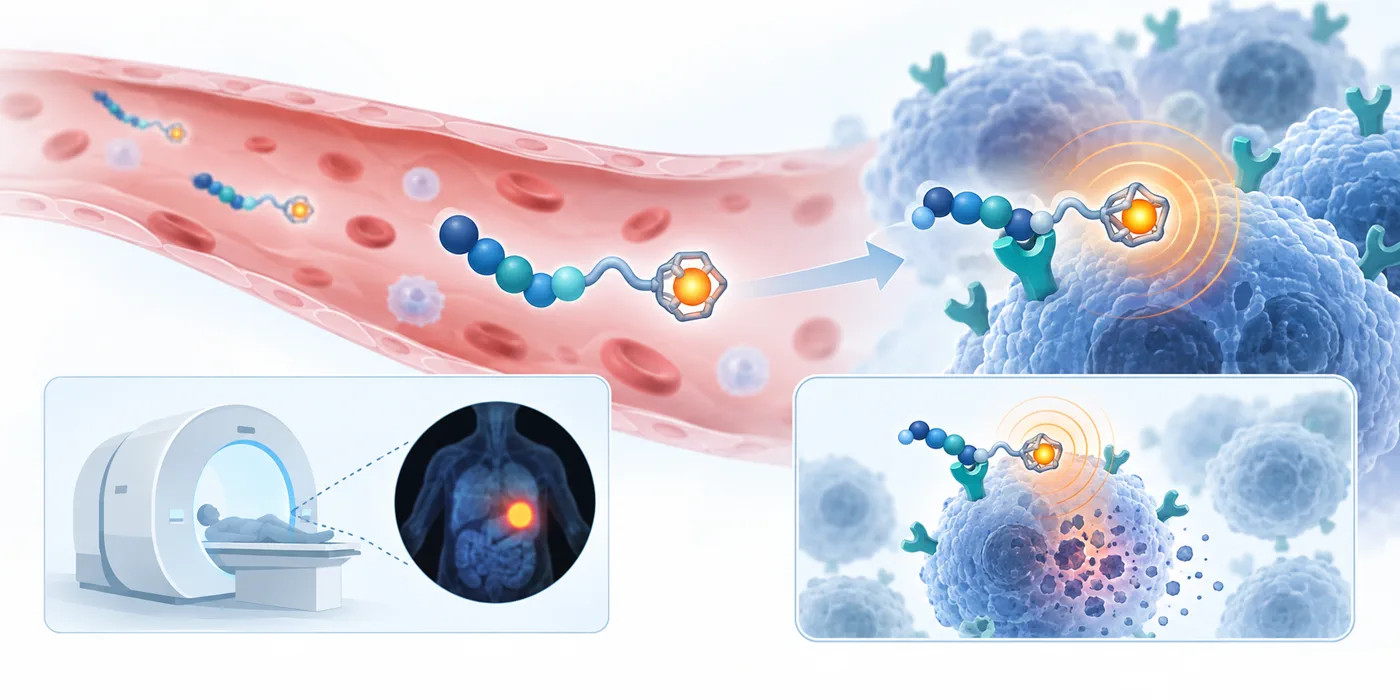
Peptides and peptidomimetics can serve as targeting carriers that deliver radionuclides to tumor tissue expressing a specific target. Schematic illustration; not a representation of any specific drug structure.
Peptides are composed of multiple amino acids and can use a continuous set of chemical groups to recognize a target surface. Changing their sequence, conformation, or cyclization pattern can also tune binding and behavior in the body. They are generally smaller than full-length antibodies, allowing them to enter tissues and clear from the blood relatively quickly, while offering a richer range of structural combinations than many conventional small molecules for target-focused modification. Nanobodies can also enter tissues effectively, but peptides and peptidomimetics offer greater flexibility in chemical synthesis and structural modification. Each carrier has conditions in which it is most suitable, but peptides provide a practical design space: they can recognize tumors and can readily be combined with the other components of a radiopharmaceutical.
Whether this “warhead” hits its mark depends first on the target. An ideal target is expressed sufficiently on tumor cells and as little as possible in important normal tissues. Whether the targeting molecule enters the cell after binding, and how long it remains in the tumor, can also affect radioactive delivery. If the drug leaves the blood too quickly, it may not have time to accumulate in the tumor; if it remains too long, it may increase radiation exposure to normal tissues. The rapid distribution and clearance of peptides can be advantageous, but these properties must be matched with sufficient tumor uptake and retention to create a suitable therapeutic window.
Attaching a radionuclide to a peptide is not as simple as “adding a label.” The linker affects the distance between the targeting component and chelator, as well as the properties of the molecule as a whole, and can therefore alter binding, distribution, and clearance. The chelator must hold a radioactive metal firmly in the body so that the radionuclide does not detach and migrate into nontarget tissues. A study of radiolabeled RGD peptides showed that even changing only the linker could alter the tumor-to-blood radioactivity ratio and uptake in the kidneys and liver.
Diagnostic and therapeutic radionuclides perform different tasks. Diagnostic radionuclides are used for imaging, helping physicians see whether a target is present, where lesions are located, and whether the targeting molecule can reach them. Therapeutic radionuclides release enough radiation to damage tumor cells. The two can use the same or closely related targeting molecules, creating a theranostic strategy of “see first, then treat.” With PSMA, for example, diagnostic imaging can identify lesions that express PSMA, while a therapeutic drug delivers lutetium-177 to those lesions. Imaging can help select patients, but treatment decisions must also account for tumor uptake, drug retention, and radiation dose to normal organs.
Novartis’s Pluvicto and Lutathera demonstrate the commercial potential of peptide-like targeting molecules. Pluvicto uses a PSMA-targeting ligand with peptidomimetic characteristics, while Lutathera uses a cyclic somatostatin analogue as its targeting component for receptor-positive neuroendocrine tumors. According to the Novartis 2025 Annual Report, the two products generated approximately USD 2.0 billion and USD 0.8 billion in sales that year, respectively. Their success does not come simply from “using peptides,” but also from clinically validated targets, suitable radionuclide combinations, patient selection, and reliable manufacturing and distribution systems. Still, they show that molecules with peptide-like recognition that can also be connected conveniently to chelators and radionuclides have become an important, established direction in radiopharmaceutical design. FDA prescribing information for Pluvicto and a technical review of lutetium-177–PSMA-617 provide further authoritative context.
The advantages of peptide radiopharmaceuticals ultimately have to be realized in the body: the drug must find the right tumor, remain there for an appropriate length of time, and deliver enough radiation to the lesion while allowing normal organs to shed unnecessary exposure quickly. Peptides and peptidomimetics provide flexible chemical tools for meeting this set of conditions, which is why they are receiving sustained attention in radiopharmaceutical research, development, and commercialization.